

WHY THE GREAT PYRAMID IS 12,000 YEARS OLD
Today, the Nile appears far from the pyramids, making it difficult to understand why the Egyptians chose that particular spot. But the ancient landscape was very different. The latest research shows that, in the past, a branch of the Nile flowed near the Giza Plateau, much closer to the monuments than it does today. A 2022 study reconstructed the so-called Khufu branch, while a 2024 study identified a broader Ahramat Branch, an ancient watercourse that ran at the foot of the western plateau, precisely where many pyramids stand. The causeways of the pyramid complexes themselves seem to point toward this ancient riverbank.
This changes the way we view Giza. The site made sense as a major monumental center when water, vegetation, and transportation converged in the same place. The overall climatic picture confirms that North Africa underwent a long African Humid Period, which began about 14,800 years ago, with a very intense phase between 9,000 and 6,000 years ago, and ended around 5,500 years ago. Historically speaking, this means that for many millennia, the Sahara was not the desert we know today, but a much greener and more hospitable region. Within this context, the Great Pyramid can be interpreted as the final result of three successive pyramids built at the same site
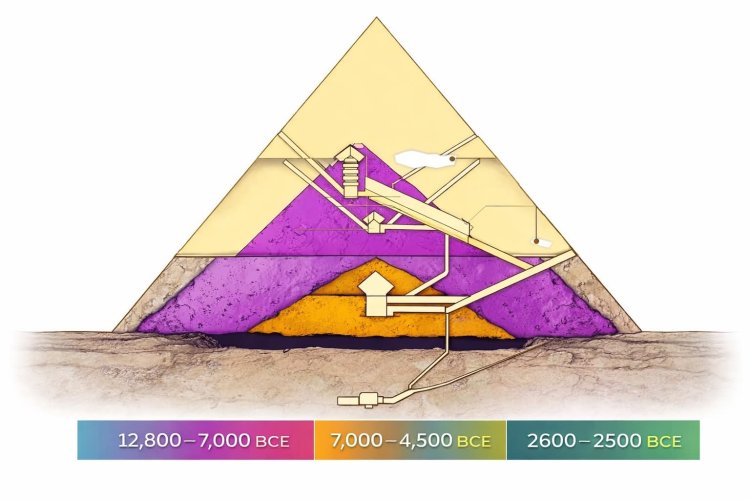
First pyramid: the original core.
The first structure was built at the height of the long favorable window opened by the African Humid Period, when the Giza region was still close to a green landscape, rich in water and logistically sensible. The most plausible date is between 12,800 and 7,000 BCE, that is, during the early and middle phases of the Green Sahara. In this phase, one should not necessarily imagine the perfect pyramid of the Old Kingdom, but rather a large artificial mound, a low pyramid, a monumentalized burial mound, or a primitive stepped structure centered on the rocky outcrop and the area of the future underground chamber. The significance of the site lies here: nearby water, vegetation, accessibility, visibility, and cultural continuity. Paleoclimatic studies, in fact, place the African Humid Period from the beginning of the Holocene until its decline in the 4th millennium BCE, with a long phase of conditions much wetter than those of the current Sahara.
Second pyramid: the geometric expansion.
At a later stage, when the site is already steeped in memory and the Nile branch is still active, the oldest core is enclosed within a more regular and taller structure. This second pyramid clearly belongs to a window between 7,000 and 4,500 BCE: the landscape is still favorable, but there is a shift toward greater territorial organization and more stable monumental forms. It is during this phase that the complex may have taken on a more recognizable geometry, with a sloping mass enveloping the previous core. The internal anomalies detected today, such as the large voids and unexpected corridors, can be interpreted as remnants of this layered construction history, not as mere isolated cavities. The Big Void detected by ScanPyramids and the corridor behind the north facade show, in fact, that the interior of the pyramid still retains a complexity that has not been fully resolved.
Third pyramid: Khufu’s final casing.
The final phase is the one known from historical chronology: the great outer pyramid attributed to Khufu, in the 26th century BCE. Here the monument is completed, cased, perfected, and transformed into the canonical form we know. This phase does not inaugurate the site: it definitively monumentalizes it. Historical and archaeological sources continue to place the visible Great Pyramid within Khufu’s reign, and the available epigraphic evidence strongly supports this attribution for the final phase.
The decisive point of the theory is simple: structures of that scale are not built against the landscape, but within the landscape. And the landscape of Giza, at its most favorable moment, belongs to the long tail of the Green Sahara and to the millennia when a branch of the Nile reached much closer to the plateau than it does today. When that water system recedes, the original logic of the place weakens. For this reason, construction in three phases spread out over time seems more natural than a single, sudden foundation on a site that was apparently already extreme and marginal. Recent studies show that the Nile branch near the pyramids gradually shrank until it disappeared; the environmental decline thus fits well with the idea of a site that began in a wetter era and concluded in a later one.
In summary, the chronological theory is as follows:
• 12,800–7,000 BCE: first monumental core, low and massive, anchored to the bedrock.
• 7,000–4,500 BCE: second pyramid that incorporates and regularizes the older core.
• circa 2600–2500 BCE: third pyramid, the visible outer one, completed during the reign of Khufu.
Thus, the Great Pyramid is no longer a single entity, but a stone archive built in three phases, born when Giza was still a threshold between water, vegetation, and the plateau, and completed when that world was already disappearing.
Sources: studies on the Khufu branch at Giza and on the Ahramat Branch of the Nile near the pyramid complexes; historical chronology of the Great Pyramid and Khufu; results from ScanPyramids on the pyramid’s internal voids; paleoclimatic syntheses on the African Humid Period.
...
The article continues in the book:
HOMO RELOADED - The hidden history of the last 75,000 years.
You can find a copy of the book at this link