…
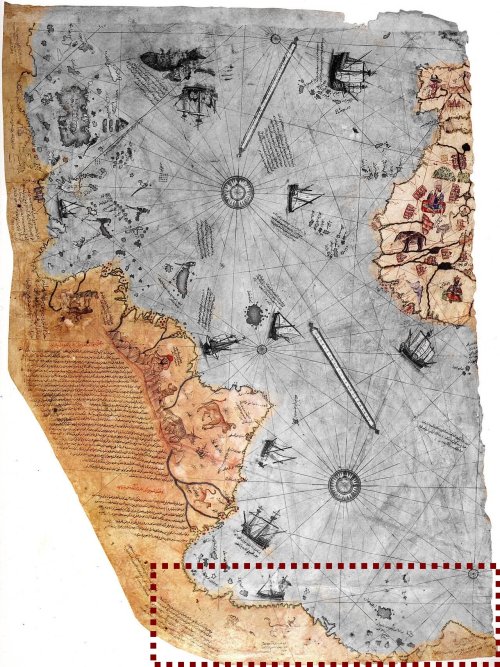
In 1929, within the walls of the ancient Topkapi Palace in Istanbul, an event took place that was destined to become one of the greatest enigmas in the history of cartography. During the palace’s conversion into a museum, a group of scholars stumbled upon a forgotten map fragment, drawn on gazelle-skin parchment. It was, in fact, a world map created in 1513 by the Ottoman admiral and cartographer Piri Reis. The significance of the artifact was immediately clear to the German orientalist Paul E. Kahle, who identified it as a creation of Piri Reis, noting a sensational detail: the map appeared to be based on a now-lost chart by Christopher Columbus relating to his voyages to the Americas.
…
Far from being a simple copy, the map is a work of synthesis. Piri Reis himself, in one of the marginal notes accompanying his work, explains in detail the method he followed, citing his sources with a transparency unusual for the time. He writes that he extracted and reduced it to a single scale from about twenty maps and Mappae Mundi, including “maps drawn in the time of Alexander, Lord of the Two Horns, showing the inhabited part of the world; eight Jaferiyes of that type and an Arab map of India, and from maps recently drawn by four Portuguese” . This statement is the first piece of a mystery that, decades after its rediscovery, continues to fascinate and divide.
…
What transforms Piri Reis’s map from a valuable historical document into a subject of heated debate is the southern portion of the surviving sheet. Here, beyond the tip of South America, a coastline is depicted extending into the ocean, in an area that was completely unexplored at the time. According to a theory proposed in the mid-20th century by scholar Charles H. Hapgood and cartographer Arlington H. Mallery, this coastline is not a fantastical representation, but the precise outline of Queen Maud Land in Antarctica, drawn as it would appear without the blanket of ice that covers it today.
…
The crux of the theory is that Antarctica was not officially sighted until 1820, and the morphology of its bedrock, buried under kilometers of ice, was first detected by modern science only during the International Geophysical Year of 1957–58, through seismic surveys. Yet, there, on a map from 1513, the coastlines already appeared to be mapped out.
…
Alleged scientific corroboration of this theory came from a seemingly unassailable source. In 1960, Charles Hapgood wrote to the U.S. Air Force requesting an evaluation. On July 6, 1960, Lieutenant Colonel Harold Z. Ohlmeyer, commander of the Technical Reconnaissance Group at Westover Air Force Base, replied with a letter destined to become famous. It reads:
…
"The assertion that the lower portion of the map depicts Princess Martha Coast in Queen Maud Land, Antarctica, and the Palmer Peninsula, is reasonable. We find this to be the most logical and, in all likelihood, correct interpretation of the map. The geographical details shown in the lower part of the map correspond remarkably well with the results of the seismic survey conducted through the ice cap by the Swedish-British Antarctic Expedition of 1949. This indicates that the coastline had been mapped before it was covered by the ice cap. The ice cap in this region is now about a mile thick." These words seemed to seal the mystery: someone, in the very distant past, had explored and mapped Antarctica when it was ice-free. But who? And how?
…
The suggestion of such an ancient and accurate map has fueled the hypothesis that Piri Reis drew upon sources dating back to an advanced and unknown civilization that flourished before the end of the last ice age. Hapgood himself, in his book Maps of the Ancient Sea Kings (1966), hypothesized that the map was based on surveys conducted by an ancient seafaring civilization, whose knowledge would have been passed down and copied for millennia until it reached the Library of Alexandria and, finally, the hands of Piri Reis.
…
Paleoclimatic studies are often cited in support of this thesis. Sediment cores taken from the Ross Sea indicate that in that region, about 6,000 years ago, the climate was temperate and the sea was ice-free. This evidence suggests that Antarctica underwent deglaciation phases more recently than previously believed, making it technically possible for a culture capable of exploring and mapping its coasts to have existed during that period.
…
Thus, current climatological knowledge suggests that it is possible the Piri Reis Map was based on an earlier map created by a people who sailed near the South Pole around 6,000 years ago, during a period of deglaciation. This additional evidence adds to the other findings that are emerging, describing a civilization of navigators that connected Nan Madol, South America, and the West African coast that was home to the Mount Atlas civilization, which later gave rise to Egypt.
…
The article continues in the book
BEFORE US THERE WAS SOMEONE
You can find a copy of the book at this link:
In 1929, within the walls of the ancient Topkapi Palace in Istanbul, an event took place that was destined to become one of the greatest enigmas in the history of cartography. During the palace’s conversion into a museum, a group of scholars stumbled upon a forgotten map fragment, drawn on gazelle-skin parchment. It was, in fact, a world map created in 1513 by the Ottoman admiral and cartographer Piri Reis. The significance of the artifact was immediately clear to the German orientalist Paul E. Kahle, who identified it as a creation of Piri Reis, noting a sensational detail: the map appeared to be based on a now-lost chart by Christopher Columbus relating to his voyages to the Americas.
…
Far from being a simple copy, the map is a work of synthesis. Piri Reis himself, in one of the marginal notes accompanying his work, explains in detail the method he followed, citing his sources with a transparency unusual for the time. He writes that he extracted and reduced it to a single scale from about twenty maps and Mappae Mundi, including “maps drawn in the time of Alexander, Lord of the Two Horns, showing the inhabited part of the world; eight Jaferiyes of that type and an Arab map of India, and from maps recently drawn by four Portuguese” . This statement is the first piece of a mystery that, decades after its rediscovery, continues to fascinate and divide.
…
What transforms Piri Reis’s map from a valuable historical document into a subject of heated debate is the southern portion of the surviving sheet. Here, beyond the tip of South America, a coastline is depicted extending into the ocean, in an area that was completely unexplored at the time. According to a theory proposed in the mid-20th century by scholar Charles H. Hapgood and cartographer Arlington H. Mallery, this coastline is not a fantastical representation, but the precise outline of Queen Maud Land in Antarctica, drawn as it would appear without the blanket of ice that covers it today.
…
The crux of the theory is that Antarctica was not officially sighted until 1820, and the morphology of its bedrock, buried under kilometers of ice, was first detected by modern science only during the International Geophysical Year of 1957–58, through seismic surveys. Yet, there, on a map from 1513, the coastlines already appeared to be mapped out.
…
Alleged scientific corroboration of this theory came from a seemingly unassailable source. In 1960, Charles Hapgood wrote to the U.S. Air Force requesting an evaluation. On July 6, 1960, Lieutenant Colonel Harold Z. Ohlmeyer, commander of the Technical Reconnaissance Group at Westover Air Force Base, replied with a letter destined to become famous. It reads:
…
"The assertion that the lower portion of the map depicts Princess Martha Coast in Queen Maud Land, Antarctica, and the Palmer Peninsula, is reasonable. We find this to be the most logical and, in all likelihood, correct interpretation of the map. The geographical details shown in the lower part of the map correspond remarkably well with the results of the seismic survey conducted through the ice cap by the Swedish-British Antarctic Expedition of 1949. This indicates that the coastline had been mapped before it was covered by the ice cap. The ice cap in this region is now about a mile thick." These words seemed to seal the mystery: someone, in the very distant past, had explored and mapped Antarctica when it was ice-free. But who? And how?
…
The suggestion of such an ancient and accurate map has fueled the hypothesis that Piri Reis drew upon sources dating back to an advanced and unknown civilization that flourished before the end of the last ice age. Hapgood himself, in his book Maps of the Ancient Sea Kings (1966), hypothesized that the map was based on surveys conducted by an ancient seafaring civilization, whose knowledge would have been passed down and copied for millennia until it reached the Library of Alexandria and, finally, the hands of Piri Reis.
…
Paleoclimatic studies are often cited in support of this thesis. Sediment cores taken from the Ross Sea indicate that in that region, about 6,000 years ago, the climate was temperate and the sea was ice-free. This evidence suggests that Antarctica underwent deglaciation phases more recently than previously believed, making it technically possible for a culture capable of exploring and mapping its coasts to have existed during that period.
…
Thus, current climatological knowledge suggests that it is possible the Piri Reis Map was based on an earlier map created by a people who sailed near the South Pole around 6,000 years ago, during a period of deglaciation. This additional evidence adds to the other findings that are emerging, describing a civilization of navigators that connected Nan Madol, South America, and the West African coast that was home to the Mount Atlas civilization, which later gave rise to Egypt.
…
The article continues in the book
BEFORE US THERE WAS SOMEONE
You can find a copy of the book at this link: