

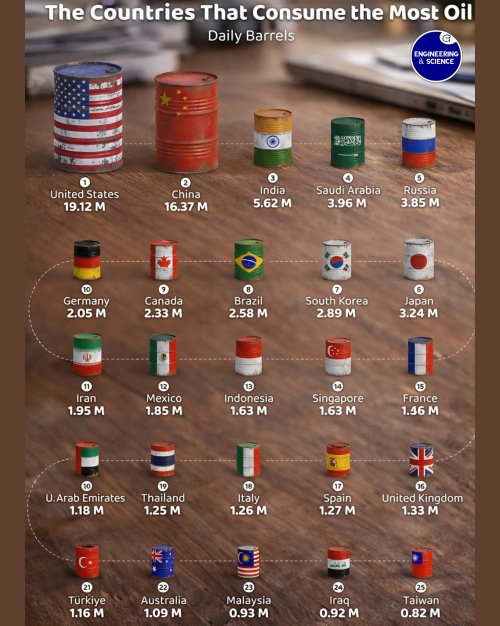
The consumption of oil varies widely across the world, but a few major economies dominate global demand. Oil is still one of the most important energy sources for transportation, industries, manufacturing, aviation, and electricity generation. Countries with large populations, strong economies, and extensive transportation networks tend to consume the most oil every day.
The United States ranks as the largest oil consumer in the world, using about 19.12 million barrels per day. This massive demand is driven by the country’s large number of vehicles, air travel, industrial production, and long-distance transportation systems. The American economy relies heavily on fuel for logistics, freight movement, and manufacturing, which keeps oil demand consistently high.
The second-largest consumer is China with approximately 16.37 million barrels per day. Over the past few decades, China’s rapid industrial expansion and urbanization have dramatically increased its energy needs. As the world’s largest manufacturing hub and one of the most populous nations, China uses enormous amounts of oil to power factories, cargo transport, construction, and infrastructure development.
In third place is India, which consumes around 5.62 million barrels daily. India’s demand for oil continues to grow due to its expanding population, rising middle class, and increasing number of vehicles on the road. Economic growth, infrastructure development, and industrial expansion are all contributing to the country’s steadily increasing energy consumption.
Several major oil-producing nations also appear among the top consumers. Saudi Arabia uses about 3.96 million barrels per day, while Russia consumes roughly 3.85 million barrels daily. Even though these countries export large quantities of oil, they still require substantial amounts for domestic industries, electricity generation, and transportation.
Other highly developed economies also show significant oil usage. Japan consumes about 3.24 million barrels per day, and South Korea uses approximately 2.89 million barrels daily. Both nations have advanced industrial sectors and rely heavily on imported oil to power manufacturing, shipping, and energy production.
Countries like Brazil, Canada, and Germany follow with daily consumption ranging between roughly 2 and 2.6 million barrels. These economies depend on oil for transportation systems, industrial output, and economic activity.
Further down the list are countries such as France, United Kingdom, Spain, and Italy, each consuming between about 1.2 and 1.4 million barrels per day. Although these nations are investing in renewable energy, oil still plays a major role in transportation and industry.
Several developing economies and regional hubs also appear among the top consumers. Countries like Thailand, United Arab Emirates, Türkiye, Australia, Malaysia, Iraq, and Taiwan consume between about 0.8 and 1.2 million barrels daily.
Overall, the chart shows how global oil consumption is concentrated in major economies with large populations, strong industries, and extensive transportation networks. As countries continue to grow and develop, energy demand is expected to remain high, although many nations are gradually exploring alternative energy sources to reduce dependence on oil.
NOTE – THERE MAY BE DIFFERENCES IN CONSUMPTION AS THIS DATA MAJORLY FOCUSES ON 2025 CONSUMPTION. DUE TO THE CURRENT WAR SITUATION, THERE MIGHT ALSO BE CHANGES CAUSED BY SCARCITY IN OIL SUPPLY.