

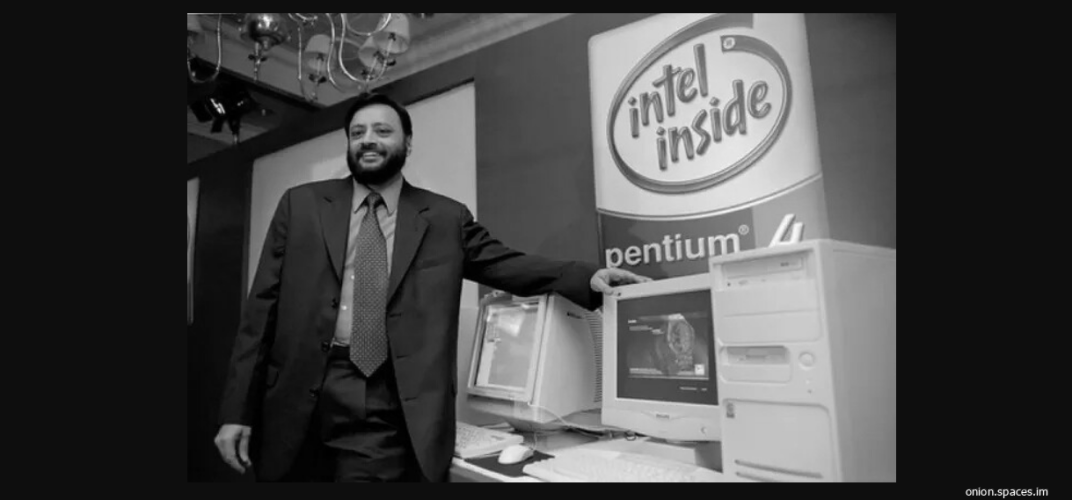
The former head of Intel in India and an iconic figure for the American chipmaker in general, Avtar Saini, has died. He was one of the leaders in the development of the legendary Intel Pentium processors, participated in the creation of the 80386 and 80486 CPUs, and was also involved in the first phase of Intel's transition from 32-bit to 64-bit microprocessor architecture.
An Iconic Figure in Intel's History
The former head of Intel India, Avtar Singh Saini, was tragically killed in a road accident. Hindustan Times reported this.
Intel India's current president and vice president of the company's client computing division, Gokul Subramaniam, expressed sadness over Saini's untimely death in a post on LinkedIn. The top manager emphasized Saini’s merits and noted that in people’s memory he will remain “a prolific inventor, an outstanding leader and a good mentor.”
Saini dedicated 22 years of his life to working at Intel. In addition to serving as the head of the office of an American corporation in India and its director in South Asia, during his career Saini took part in the development of a number of processor models for personal computers and servers, often in leading roles. According to Tom's Hardware, Saini personally owned seven patents for inventions in the field of microprocessors.
In addition, Saini is credited with a significant role in the deployment of Intel's R&D center to Intel territory.
Details of the accident
In the morning, at 5:50 local time, 68-year-old Saini, in the company of strangers, was cycling along Palm Beach Road in Nerul, an elite area of Navi Mumbai (Maharashtra, India).
Soon the company was overtaken by a taxi moving at a clear speed limit. Contrary to the group's expectations, the car did not get ahead of the cyclists. Instead, he drove into a cyclist from behind, who did not expect such a development of events, and dragged him on the hood for several tens of meters.
The cyclists accompanying Saini found him alive and conscious and quickly took the victim to the nearest hospital. The efforts of the doctors were not enough, and the man soon died from his injuries, which could not be prevented by the bicycle helmet and other items of equipment that, according to his friends, Saini always put on before leaving.
The chronicle of further events differs in the presentation of various Indian media. Thus, according to Mint, the driver of the car chose to immediately flee the scene of the incident, taking with him the remains of a bicycle stuck under the bottom of the body. The police allegedly have not yet been able to detain the alleged culprit of the accident, and a criminal case has been opened against him under three articles of the criminal code.
Hindustan Times, citing eyewitnesses to the accident, reports that the taxi driver stopped and was detained by passers-by until the police arrived, who then arrested him.
Significant contributions to Intel's breakthrough products
Saini received a B.E. degree in Electrical Engineering from the Victoria Jubilee Institute of Technology (Mumbai, India), and graduated from the University of Minnesota (USA) with a Master's degree in Electrical Engineering.
Saini joined Intel in 1982 and initially served as general manager of the corporation's microprocessor division in Santa Clara, California, USA.
Saini, in particular, was one of the two key leaders in the development of the legendary Intel Pentium line of CPUs. Pentium chips built on the x86 architecture replaced the no less legendary Intel 80486 in 1993 and until 2008 remained the main brand of PC processors in the world. By the way, Saini also had a hand in the development of Intel 80386 and 80486.
Subsequently, and until 2023, budget CPU models were produced under the Pentium brand, and the Intel Core family ruled the roost. In the fall of 2022, Intel announced that the Celeron and Pentium lines will be united under the common Intel Processor brand. The Intel Core family has also been rebranded.
The Transition to 64 Bits and the Failed Itanium
Saini was also involved in the first phase of Intel's transition to a 64-bit processor architecture. By 2001, through the efforts of Intel and HP engineers, the IA-64 architecture was created, on the basis of which the first Itanium CPUs were built. The Itanium experience overall was not very successful for Intel, and in February 2019 the company announced that it would stop shipping IA-64 processors in 2021.
In November 2023, Itanium support was finally and irrevocably removed from Linux. The technology was declared “dead” by the kernel developers two years before this decision was made.