
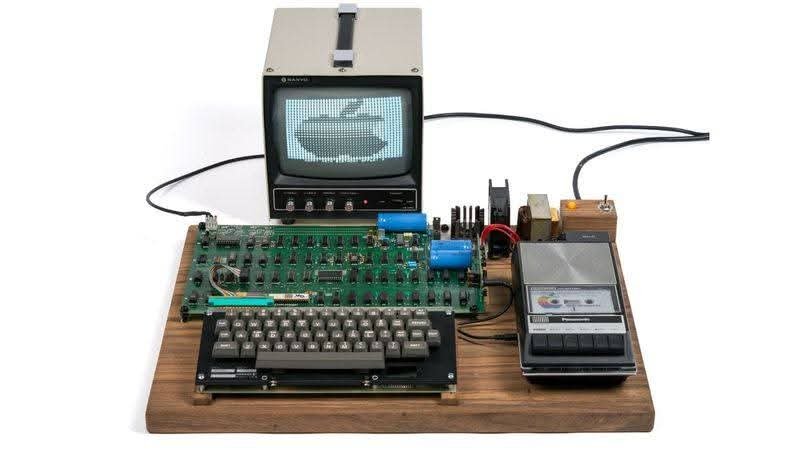
A 25-year-old HP employee built a personal computer from $25 chips in his spare time. His employer rejected the design five times. That rejected side project became Apple, now worth almost $4 trillion.
Steve Wozniak, the Apple I, 1976.
Wozniak did not set out to build a computer. He was designing a cheap terminal so he could dial into ARPANET, the network that would later become the internet. Then MOS Technology released the 6502 microprocessor for $25 when the Intel 8080 had launched at $360 and was still retailing around $179 at the time. He bought the 6502 and redesigned his terminal into a full computer.
He brought the design to the Homebrew Computer Club and handed out the schematics for free. His friend Steve Jobs had a different idea and convinced him they should sell it instead.
To fund the first batch of boards, Wozniak sold his HP scientific calculator and Jobs sold his Volkswagen van. That was the entire startup capital.
There was also a third founder. Ronald Wayne was older than the two Steves and drafted the original partnership agreement in exchange for 10 percent of the company. Twelve days later he got cold feet and sold his share back for $800. That same 10 percent would be worth up to $400 billion today.
Before Apple, Wozniak and Jobs had already been hacking. They built blue boxes, illegal devices that played specific tones into a phone handset to trick the Bell system into giving free long-distance calls. Wozniak reverse-engineered the tone system from a magazine article and Jobs sold the boxes to fellow students. They were phone phreakers long before they were computer makers.
Wozniak also had trouble getting the Apple I to run. Chuck Peddle, the engineer who designed the 6502 at MOS Technology, stopped by the garage while on a sales trip to the west coast. He brought a development system and helped them get it working.
The Apple I itself sold around 175 units and never made anyone rich. But it proved a real computer could fit on a single board, cost less than a thousand dollars, and be built by one person in a garage.
Today that project runs:
→ In the pocket of over 1.5 billion iPhone users
→ On more than 100 million Mac computers worldwide
→ Inside a company with 166,000 employees
→ At a market cap of almost $4 trillion, one of the top 3 most valuable companies in the world
All of it started because HP said no, and a young engineer kept going anyway.
Never underestimate an engineer who can't afford a terminal.
 Save and share this.
Research & writing: Jolanda de Koff | HackingPassion.com