

No nuclear weapons.
No invasion.
Just a statement that changed the entire strategic equation.
Seven words reportedly summed it up:
“Open for all. Closed for the U.S. and Israel.”
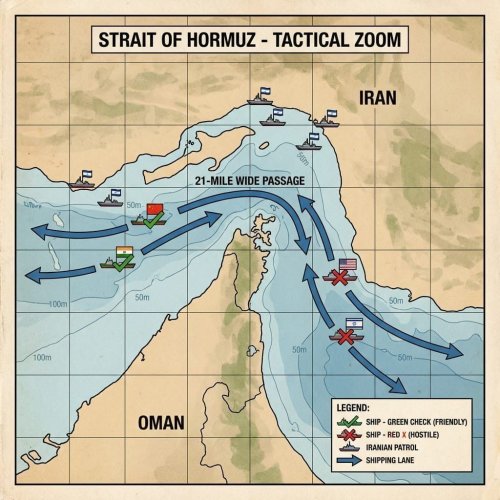
And the location that matters is the Strait of Hormuz.
One narrow passage.
Roughly 21 miles wide.
Yet it carries a massive share of the world’s oil.
Now that waterway has effectively become a geopolitical test for countries across the globe.
 Japan receives about 70% of its oil through the Strait
South Korea depends on the same route for a similar share of its energy imports
Tankers linked to India have reportedly continued transiting the route
Oil shipments tied to China are also still moving through the corridor
Several countries appear to be navigating the situation quietly through diplomacy
Then something unusual happened.
Donald Trump called on multiple countries to help secure the waterway.
In a post on Truth Social, he urged nations such as France, Japan, China, South Korea, and the United Kingdom to contribute ships.
His message was clear.
Global shipping lanes require global protection.
But that request also creates a strategic dilemma.
Here’s the trap many analysts are discussing:
→ If allied countries send warships, they risk being pulled deeper into the conflict with Iran
→ If they refuse, pressure builds on the United States to secure the route alone
→ If countries negotiate directly with Iran to ensure passage, it changes the diplomatic balance of power in the region
In every scenario, alliances and energy flows are being tested at the same time.
Meanwhile the economic pressure is rising.
 Oil prices have climbed above $100 per barrel
Energy markets are becoming more volatile
Global stock markets are reacting to the uncertainty
Iranian officials are openly framing the situation as proof that Western security guarantees have limits.
For example, Abbas Araghchi recently argued that the conflict shows weaknesses in the traditional security structure built around the United States.
Whether that claim proves accurate remains to be seen.
But the strategic message is clear.
This conflict is no longer only about missiles, drones, or airstrikes.
It is about alliances, trade routes, and global influence.
And right now, the Strait of Hormuz has become the center of that geopolitical contest.
If you're seeing this post, the Algorithm hasn't buried it yet. Share it so more people understand what's happening behind the headlines. Many people will wish they followed me sooner.
No invasion.
Just a statement that changed the entire strategic equation.
Seven words reportedly summed it up:
“Open for all. Closed for the U.S. and Israel.”
And the location that matters is the Strait of Hormuz.
One narrow passage.
Roughly 21 miles wide.
Yet it carries a massive share of the world’s oil.
Now that waterway has effectively become a geopolitical test for countries across the globe.
Then something unusual happened.
Donald Trump called on multiple countries to help secure the waterway.
In a post on Truth Social, he urged nations such as France, Japan, China, South Korea, and the United Kingdom to contribute ships.
His message was clear.
Global shipping lanes require global protection.
But that request also creates a strategic dilemma.
Here’s the trap many analysts are discussing:
→ If allied countries send warships, they risk being pulled deeper into the conflict with Iran
→ If they refuse, pressure builds on the United States to secure the route alone
→ If countries negotiate directly with Iran to ensure passage, it changes the diplomatic balance of power in the region
In every scenario, alliances and energy flows are being tested at the same time.
Meanwhile the economic pressure is rising.
Iranian officials are openly framing the situation as proof that Western security guarantees have limits.
For example, Abbas Araghchi recently argued that the conflict shows weaknesses in the traditional security structure built around the United States.
Whether that claim proves accurate remains to be seen.
But the strategic message is clear.
This conflict is no longer only about missiles, drones, or airstrikes.
It is about alliances, trade routes, and global influence.
And right now, the Strait of Hormuz has become the center of that geopolitical contest.
If you're seeing this post, the Algorithm hasn't buried it yet. Share it so more people understand what's happening behind the headlines. Many people will wish they followed me sooner.