

Intel Corporation, during the ISC 2023 conference, as reported by AnandTech, shared information about the Aurora project to create a supercomputer with exascale performance. This system is being created for the Argonne National Laboratory of the US Department of Energy.
Initially, the announcement of the Aurora HPC complex took place back in 2015 with an expected launch in 2018: it was expected that the machine would provide performance at the level of 180 Pflops. However, the implementation of the project was significantly delayed, and the technical parameters of the platform were changed several times. So far, the Sunspot test cluster has been deployed.
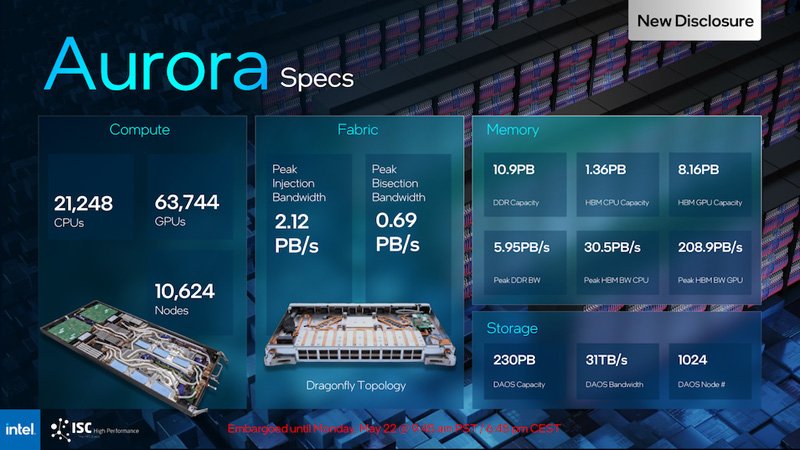
As it is now reported, in the final configuration, Aurora will integrate 10,624 nodes, each of which will include two Xeon Max processors and six Ponte Vecchio accelerators. Thus, the total number of CPUs will reach 21,248, the number of GPUs will be 63,744. The performance of FP64, as previously stated, will exceed 2 Eflops.
Each processor operates 64 GB of HBM memory, the accelerator - 128 GB. This adds up to 1.36 PB and 8.16 PB of HBM memory respectively, with peak throughputs of 30.5 PB/s and 208.9 PB/s. In addition, the system will be able to use 10.9 PB of DDR5 memory with a bandwidth of up to 5.95 PB/s. The capacity of the data storage subsystem will be 230 PB with an operating speed of up to 31 TB/s.

To date, Intel has delivered more than 10 thousand “blades” for Aurora, which means that almost all nodes are ready for final installation. The supercomputer is scheduled to be put into operation this year. A specialized scientific model of generative AI is being prepared for the NPC platform - Generative AI for Science, which has about 1 trillion parameters. Aurora is planned to be used to solve the most resource-intensive tasks in various areas.