

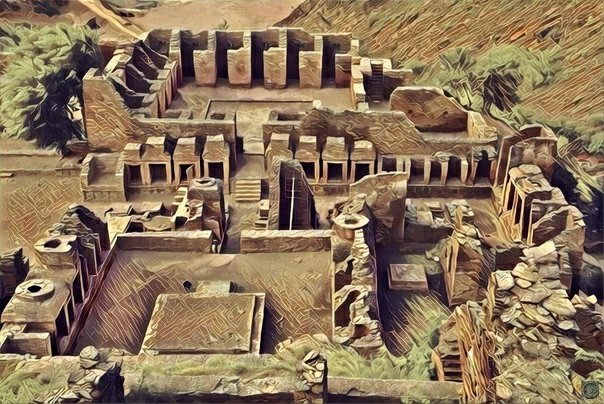
The Indus or Harappan civilization is the third ancient Eastern bronze civilization in terms of appearance, after the Egyptian and Mesopotamian. Of all three, it occupied the largest area, exceeding 2 times the total area of the other two. The Indus civilization declined relatively quickly, having flourished between 2600 and 1900 BC. e., which is associated with the drought of the 2200s BC. e.
The Harappan civilization developed in the Indus River valley from 3300 to 1300 BC. e. The most significant centers are Rakhigarhi (350 hectares), Mohenjo-Daro (300 hectares), Harappa (150 hectares), Lothal (60 hectares) and Dholavira (47 hectares). The population at its height was about 5 million, presumably Elamito-Dravidian. The mature period of development of the Indus civilization lasted from 2600 to 1900 BC. e. It extended across the territories of present-day Afghanistan, Pakistan and North-West India.
In Sumerian texts, the Harappan civilization was supposedly called "Meluhha".
During the 3rd millennium BC. e. aridization began - the gradual depletion of water resources in the region where the state was located. Archaeologists cite increased urbanization in the region and the gradual draining of soils and rivers as a possible reason for aridization. Ultimately, this could lead to the decline of the state. Moreover, after the decline, the population went to the East.
The first data on the existence of pre-Aryan civilization in western India were published in the 19th century by Alexander Cunningham. The existence of the Indian civilization was finally established in 1921-1922 by an expedition led by John Marshall.
The inhabitants of the Indus River Valley developed a number of new crafts - carnelian processing, bone processing, bronze, copper, lead and tin metallurgy. The cities of the Harappan civilization are distinguished by clear planning of buildings. The building material is baked clay brick. Complex drainage systems, water supply systems and entire clusters of large non-residential buildings were mastered and used.
During excavations of cities, both children's toys and a small amount of weapons were found, which indicates a weak militarization of the state and relatively peaceful periods of existence. The development was focused on trade with distant lands, further than Babylon, Sumer and southern Mesopotamia. Developed trade is indicated by numerous seals decorated with animals and mythical creatures.