
Google recently released new information in its Search Center, primarily focusing on optimization guidelines for "Google Search's generative AI tools." Previously, various approaches were offered, but no clear guidelines existed. As Google has incorporated generative AI features into its search engine (such as AI Overview), and AI tools have become increasingly prevalent in how modern people search for information, the way users obtain information has indirectly changed. Website owners are anxious about a significant decrease in search traffic, yet they lack a clear strategy to optimize their websites.
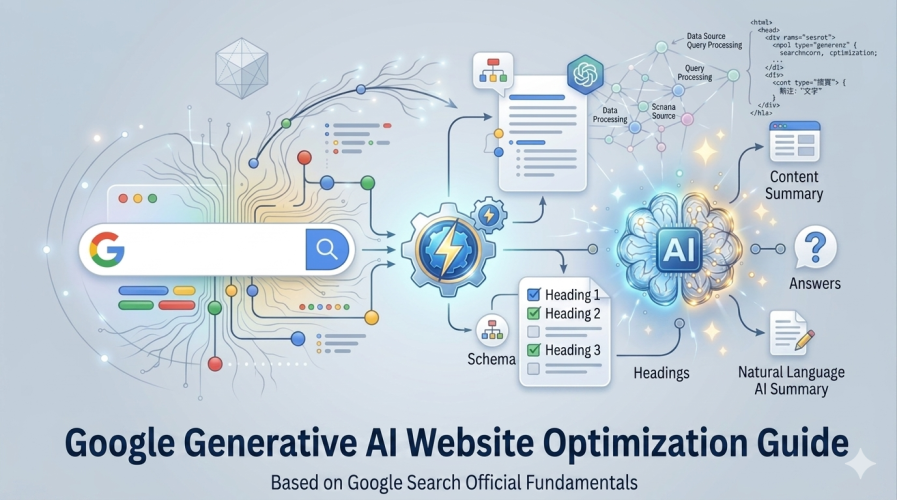
Google has taken a rare step by addressing this issue, releasing a " Google Search Generative AI Feature Optimization Guide ." To put it simply, SEO remains the foundation of AI search , so the argument that "SEO is dead" often seen online is actually incorrect. Even though many new terms have been created, such as AIO (AI Search Optimization), AEO (Answer Engine Optimization), or GEO (Generative Engine Optimization), their core still revolves around SEO, which is the search engine optimization part that everyone is familiar with.
So how do you stand out in AI tools? Google's answer is simple: " Do a good job with SEO ."
Regarding the question of whether AI tools can be used to assist in content creation, which is of great concern to everyone, Google stated that as long as it complies with basic search guidelines and does not violate content abuse policies, it is within the acceptable range.
Other key points that Google frequently emphasizes include: providing a good browsing experience for users, ensuring that websites display well on all devices, reducing website latency, making it easy for users to distinguish the main content from other elements on a page, and reducing the problem of duplicate content.
However, I personally believe that converting web page content to Markdown will be effective in reducing search engine crawling budget, which in turn will allow for more budget to be available for storing more content.
While AI Agents are mentioned at the end of the article, the discussion is brief and lacks detail. Further updates and explanations may be provided later. Users must stay informed about emerging technologies and services, as everything moves rapidly in the AI era, and these technologies may have varying degrees of impact on websites.
Google has taken a rare step by addressing this issue, releasing a " Google Search Generative AI Feature Optimization Guide ." To put it simply, SEO remains the foundation of AI search , so the argument that "SEO is dead" often seen online is actually incorrect. Even though many new terms have been created, such as AIO (AI Search Optimization), AEO (Answer Engine Optimization), or GEO (Generative Engine Optimization), their core still revolves around SEO, which is the search engine optimization part that everyone is familiar with.
So how do you stand out in AI tools? Google's answer is simple: " Do a good job with SEO ."
Key Takeaways: Officially Certified Optimization Directions
The website administrator can focus their efforts on the following three essential optimization directions:1. Produce unique content
This is also a very important concept mentioned in the Google SEO Beginner's Guide : "Treat EEAT as a ranking factor." Simply put, it means creating practical, reliable, and user-centric content (human-centered, not commoditized content), and ideally adding personal experience or professional insights, while avoiding generic copying of content. This makes it more likely to be favored by generative AI tools.Regarding the question of whether AI tools can be used to assist in content creation, which is of great concern to everyone, Google stated that as long as it complies with basic search guidelines and does not violate content abuse policies, it is within the acceptable range.
2. Optimization of technical architecture
This part is entirely consistent with SEO, ensuring that web pages can be successfully retrieved and indexed by Google . The core of the AI system is enabling Google's search engine to find and correctly process your pages. If your website has already undergone search engine optimization (SEO), these efforts will still be very helpful for future generative AI search optimization.Other key points that Google frequently emphasizes include: providing a good browsing experience for users, ensuring that websites display well on all devices, reducing website latency, making it easy for users to distinguish the main content from other elements on a page, and reducing the problem of duplicate content.
3. Make good use of multimedia
Adding high-quality images and videos to a website can potentially drive more traffic. Google states that users prefer to see images and videos when searching for content online, and having appropriate images and videos can help increase visibility in AI search results.Clarifying Misconceptions: AI Myths Website Owners Can Ignore
In this guide to optimizing generative AI search, I think the most useful section for readers is "Debunking the Myths of Generative AI Search: What You Don't Need to Do." Google has compiled some of the most popular topics (and optimization practices) surrounding generative AI and Google Search online, and then tells you which techniques are actually unnecessary and don't need to waste your time.1. No llms.txtspecial machine files need to be created.
In the past, many people have advocated adding llms.txtfiles to websites (a plain text file placed in the root directory of a website, providing standardized information about the website's content, structure, and authorization to large language models), or Cloudflare's " Markdown for Agents " which automatically converts content to Markdown format. Google says that these files will not be treated specially.However, I personally believe that converting web page content to Markdown will be effective in reducing search engine crawling budget, which in turn will allow for more budget to be available for storing more content.
2. There is no need to deliberately chunk the content.
Many people, like myself, probably chuckled upon seeing this. After the emergence of generative AI services, some argued that content should be broken down and given H2 and H3 headings to increase its chances of being cited by AI. Google directly refuted this approach in this guideline , simply stating that pages should still be audience-centric, not just designed to cater to AI search algorithms.3. There's no need to deliberately change your writing style for AI.
Another important point for website administrators to note in this guide is that Google states there is no need to adopt a specific writing style (or rewrite old articles in a new style) to cater to AI search algorithms. AI can associate synonyms and different keywords in the content that users search for. Unlike the early days when web pages had to be stuffed with a bunch of "long tail" keywords, this approach is obviously outdated. You only need to maintain your own writing style.Summarize
I recommend that everyone read the original article " Google's Guide to Optimizing for Generative AI Features on Google Search ". The article is not too long. It was initially only available in English, but now the Traditional Chinese version is also available (May 21).While AI Agents are mentioned at the end of the article, the discussion is brief and lacks detail. Further updates and explanations may be provided later. Users must stay informed about emerging technologies and services, as everything moves rapidly in the AI era, and these technologies may have varying degrees of impact on websites.