

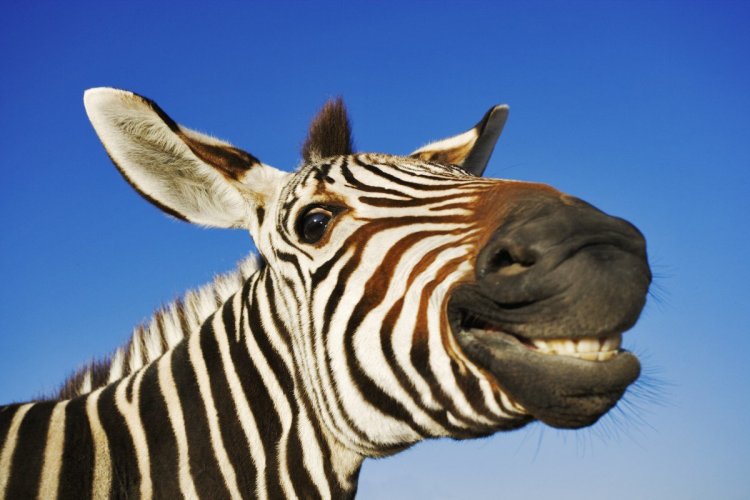
The intrigue is over a hundred years old - the question “Why is a zebra striped?” has tormented biologists since the time of Charles Darwin. A variety of assumptions have been made here: that the stripes make zebras invisible to predators, that they somehow cool them, that they protect them from insects. Research in recent years supports the latter hypothesis - that stripes protect zebras from bloodsuckers. Not so long ago we wrote that horseflies are less likely to land on striped surfaces, and those experiments were carried out not even with zebras, but with human mannequins.
An article recently published in PLoS ONE adds more details: it turns out that insects actually have a hard time landing on stripes. Experiments were carried out with both zebras and horses covered with different blankets: striped or plain (white and black). Horseflies circled over all the animals, but in general, four times fewer horseflies landed on a zebra than on a one-ton horse, and in horses with a zebra-shaped blanket, the uncovered head suffered the most from insects: if in half an hour five horseflies landed on the body, then on the head - ten times more. It turned out that the horseflies, wanting to sit on the striped rump, could not slow down in flight and either flew past or crashed into the surface. That is, we can say that the stripes prevent insects from performing landing maneuvers.
Source: Science and Life magazine