

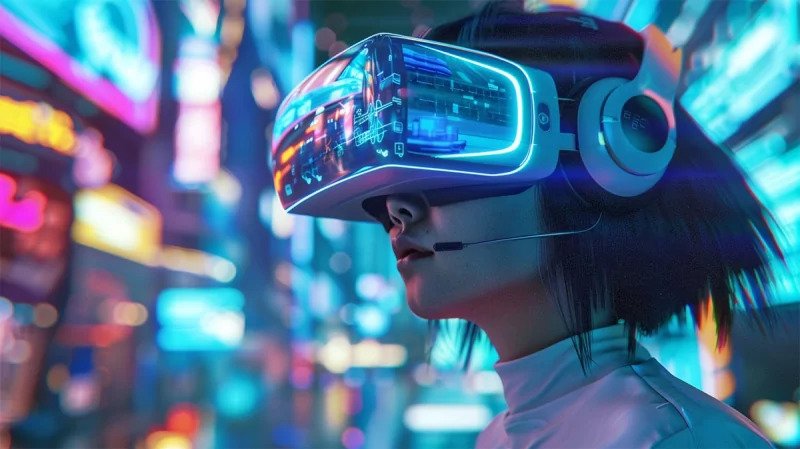
The Metaverse is often described as the inevitable evolution of the Internet. But what exactly is the metaverse and what will it become in the future?
Imagine a virtual world in which billions of people live, work, shop, learn, and interact with each other—all without ever leaving their couch in the physical world.
In this world, the computer screens that we use today to connect to the worldwide information network become portals to a tangible three-dimensional virtual world, similar to real life, only bigger and better. Digital copies of ourselves, or avatars, can move freely around this virtual world, erasing any boundaries of interaction.
All this is usually meant by the metaverse. However, despite the general hype, today it does not exist in the form in which it was described above. Nevertheless, gradually everything is moving towards this, with slow but sure steps.
In this article, we will look at how to prepare for the arrival of the metaverse when it happens, and how to competently transform your business for it.
The neural network boom happened quickly and unexpectedly. The same thing can happen with the metaverse, so we need to be prepared in advance for what may await us in the near future.
Why is the metaverse important?
“Metaverse” became a household word when Facebook rebranded to Meta in October 2021 and announced plans to invest at least $10 billion in the concept that same year.
In addition to Meta, various tech giants are investing billions of dollars in the concept of metaverses, including Google, Microsoft, Nvidia and Qualcomm.
Consulting firm McKinsey & Company optimistically predicts that the metaverse economy could reach $5 trillion by 2030. E-commerce is expected to become the dominant driver of the industry, with gaming, entertainment, education and marketing in the metaverse to be important aspects driving its future development.
Today, companies use the term "metaverse" to refer to many different types of enhanced online environments. These range from online video games like Fortnite to new virtual workspaces like Microsoft Mesh or Meta's Horizon Workrooms.
Instead of a single shared virtual space, the current version of the metaverse is presented as a multiverse, that is, multiple metaverses with limited interoperability since each is developed by different companies.
The simultaneous combination of endless enthusiasm from companies and deep uncertainty about exactly what form the metaverse will come into our lives is causing mixed reactions from the public to this promising phenomenon.
There are still many questions about the technology. For example, will the metaverse ultimately be very different from the digital experience we have today? And if so, will humanity be ready to spend long hours every day in a bulky headset, navigating the digital space.
Be that as it may, futurologists argue that, although the metaverse is just beginning its development, and fundamental technical barriers to its operation still exist, sooner or later it will still happen and loudly declare itself to the whole world.
“This is clearly one of the most anticipated technology advances of the coming decade,” said Dave Wright, chief innovation officer at IT provider ServiceNow.
How will the metaverse work?
Since the metaverse is largely unbuilt, there is no consensus on exactly how it will function. Broadly speaking , the metaverse is a digital ecosystem built on various types of hardware, real-time collaboration and collaboration software, and blockchain-based decentralized finance tools.
How the metaverse pans out will depend on factors such as the degree of interaction between virtual worlds, data portability, controls, and user interfaces.
Lauren Lubetzky, a senior manager at Bain & Company, speaking in a session on the metaverse at the MIT Platform Strategy Summit 2022, expressed concerns about the development of this technology, including the possibility of the metaverse remaining the domain of niche applications used by consumers for entertainment and gaming, but far from comprehensive virtual reality. However, this is only one of the possible scenarios for the development of the metaverse.
How will the metaverse be accessed?
Two technologies that are considered important to the development and growth of the metaverse are virtual reality and augmented reality.
Virtual Reality (VR) is a simulated three-dimensional environment that allows users to interact with a virtual environment in a way that approximates the reality perceived by our senses.
These virtual environments are now accessed through a virtual reality headset that captures the user's entire field of view. And various haptic elements, including gloves, vests, walking platforms and even full-body tracking suits, provide more realistic interaction with the virtual environment.
Augmented Reality (AR)is a less immersive technology than VR. It just adds digital overlays on top of the real world, but that's essentially the beauty of the technology. AR allows you to live your ordinary life without falling out of reality, but look at some things in a completely new way, diversifying your interaction
What is the metaverse, why is it needed and when will it come into our lives?
with the outside world.The once popular game Pokémon Go is an early example of augmented reality technology. Google Glass and head-up displays on car windshields are also well-known consumer AR products.
It remains to be seen whether VR and AR will become the main interfaces of the metaverse, but they will definitely play their role in its formation and development. Nowadays, many early metaverses can be accessed without full immersion through gaming platforms such as Fortnite or Roblox. And some of the most high-profile VR experiences in building a metaverse are VRChat and Decentraland (this is if we do not consider solutions from Meta and Microsoft).
How are virtual reality and the metaverse related to each other?
VR is often associated with the metaverse, but the terms are not synonymous. As noted above, individual virtual reality technologies only provide the means to interact with the larger platforms of the multiverse.
As part of this role, VR can support multiple uses of the metaverse. For example, virtual reality can be combined with the related field of digital twin technology, which allows organizations to create virtual representations (copies) of physical spaces, devices, machines or processes.
VR Contributes to the Industrial Metaverse
Virtual reality and the concept of digital twins represent some of the fundamental building blocks for the emerging industrial metaverse.
The industrial metaverse is capable of bringing digital replicas of real objects into a broader virtual environment spanning machines, factories, products and supply chains.
Industrial design is one promising application of the metaverse. Organizations can use VR to consider the consequences of various design decisions, create simulated prototypes to avoid the cost of creating physical ones, and more.
Virtual reality can be used to train employees of various industries, for example, in safety procedures, especially when the cost of a mistake is someone’s life. Assembly line workers, for example, can train in a virtual environment before entering the physical shop floor.
Emergency services personnel can use VR to practice scenarios such as natural disasters - to train in a safe environment.
In medicine, VR will allow inexperienced surgeons to repeat a certain procedure as often as necessary, which will significantly reduce training time and increase the final skills of the doctor.
Overall, reducing costs and risks is one of the key benefits of using virtual reality in the workplace, and the advent of the metaverse should only encourage widespread adoption of the practice.
VR promotes corporate training
Virtual reality can find much wider corporate applications, including high-complexity scenarios such as pilot training, astronaut training, empathy lessons and training in various soft skills, which include communication and management skills, as well as effective thinking and control of emotions.
Thus, a study by the consulting company PwC showed that participants in soft skills training who completed it in virtual reality completed it four times faster than those participants who studied in a regular classroom.
The same study noted that participants who completed a VR course were then 275% more confident in their soft skills. Greater confidence comes not only from the use of an immersive approach, but also from students' ability to repeatedly practice skills in a comfortable environment.
Indeed, learning is likely to be an important fruit of the development of the metaverse, given the possibility of virtualizing any scenarios, especially those that are expensive or time-consuming to recreate in the physical world.
Other technologies of the metaverse
In addition to virtual reality, some other technologies also play a role in the formation of the metaverse, but their final list has not yet been formed.
In her article "The 7 Best Technologies for Metaverse Development," technology writer Esther Schein listed the foundational components that she believes will have the greatest impact on the development of the metaverse over the next decade. These technologies were:
-- Artificial intelligence;
-- Internet of things;
-- Extended reality, including VR and AR;
-- Brain-computer interfaces;
-- 3D modeling and reconstruction;
-- Spatial and edge computing;
-- Blockchain.
What is the difference between the Internet and the metaverse?
The Internet is a network of billions of computers, millions of servers and other electronic devices. While online, Internet users can communicate with each other, browse and interact with websites, and buy and sell goods and services.
The metaverse, in turn, does not compete with the Internet - it relies on it. The Internet is something that people will continue to use one way or another while inside the metaverse.
How do NFTs fit into the metaverse?
Non-Fungible Tokens (NFTs) play a large role in the utility and popularity of the metaverse. NFTs are a secure type of digital asset based on the same blockchain technology as cryptocurrency.
However, instead of currency, an NFT can represent a piece of art, a song, or digital real estate. An NFT gives the owner a kind of digital document or proof of ownership that can be bought or sold in the metaverse.
Metaverse Group positions itself
What is the metaverse, why is it needed and when will it come into our lives?
as the world's first virtual real estate company. It acts as an agent facilitating the purchase or rental of real estate or land in several virtual worlds of the metaverse. Offerings include meeting rooms and commercial spaces, art galleries, family homes and 'hangout spaces'.While the metaverse has created opportunities for new companies such as Metaverse Group to offer digital products, established traditional companies are also gradually joining the virtualization process. For example, Nike acquired RTFKT, a startup that makes one-of-a-kind virtual sneakers.
Nike has also partnered with Roblox, and together the companies have built a digital world, “Nikeland,” where Nike fans can play games and dress their avatars in branded sportswear.
“NFTs and blockchain lay the foundation for digital property,” said Nick Donarski, co-founder of the Ore System, an online community of gamers, content creators and game developers. “Owning your real identity will move into the metaverse, and that medium will be NFTs.”
Companies of the Metaverse
Three major software vendors have their own views on the metaverse and will likely have the greatest influence on its formation and development. Let's take a look at these companies below.
Meta. “We will now be a metaverse, not just Facebook,” CEO Mark Zuckerberg wrote in his October 2021 announcement of the brand change. This is an important change because it means that users will eventually not need a Facebook account to use other services in the metaverse. Among other non-Facebook products, Meta has already sold millions of its Meta Quest VR headsets for navigating the metaverse.
Zuckerberg also said the company is committed to accelerating the development of fundamental technologies, including social platforms and creative tools needed to "bring the metaverse to life." So, after news of the rebranding appeared at the end of 2021, Meta launched Horizon Worlds, a VR space in which users can navigate as a digital avatar. The company also provided developers with tools to create additional virtual worlds.
Skeptics see Meta's massive investment in the metaverse as a gamble, as the company is taking a big risk in today's volatile economy. However, Mark Zuckerberg seems to be confident that this is the future, otherwise he would not have undertaken rebranding and would have taken very significant risks for his business.
Epic Games.The creators of the popular online shooter Fortnite and the Unreal Engine game development software have a slightly different idea of the metaverse, unlike the same Meta. The company wants to provide a common space for users to interact with each other without focusing on advertising.
While Epic Games doesn't yet have a VR solution for metaverses, the company is actively experimenting with the concept of metaverses in Fortnite, where the developers periodically host concerts by famous musicians such as Travis Scott, Ariana Grande and Eminem.
Microsoft. Among the “small-soft” ones, the metaverse is also in its infancy. Introduced in May 2023, the Microsoft Mesh platform allows Microsoft Teams users in different physical locations to collaborate in immersive virtual meetings.
The platform includes a suite of AI-powered tools for creating and interacting digital avatars, session management, spatial visualization, synchronization between multiple users, and “holoportation,” a 3D capture technology that allows users to reconstruct and transmit high-quality 3D models of people in real life. time.
Microsoft is actively working with Accenture to create Mesh-enabled immersive spaces. Accenture, in turn, hires more than 100,000 people annually and uses Microsoft Mesh to onboard new employees. Employees meet on Teams to receive instructions on how to create a digital avatar and access One Accenture Park, a shared virtual space that is part of the onboarding process.
The futuristic space, reminiscent of an amusement park, includes a central conference room, a virtual boardroom and digital monorails that take new employees to various exhibitions.
When will a full-fledged metaverse appear?
Although the idea of living and interacting in a virtual world has existed for many years, a real metaverse where realistic and natural interactions are possible still seems something distant and futuristic.
In his 2021 review blog, former Microsoft CEO Bill Gates noted that most people don't have virtual reality glasses and motion-capture gloves that can accurately capture their facial expressions, body language and voice quality. But until the product receives mass distribution, it’s clearly not worth talking about transforming the concept of metaverses into something more.
However, Gates predicted that in the coming years, most virtual meetings will move from two-dimensional images on Zoom to three-dimensional spaces in which participants appear as digital avatars.
How will the metaverse affect the future?
It should be emphasized that the metaverse is still a set of hypothetical possibilities, not an actual reality. There are still many unknowns.
What exactly would a real metaverse look like? How
What is the metaverse, why is it needed and when will it come into our lives?
Will there be a seamless transition between worlds supported by different companies, and will such a transition be available in principle? Or maybe the current market players will unite and create a single digital space from scratch? In this case, who will control this space and how? So far there are far more questions than answers.For now, the metaverse remains the subject of active debate. Proponents of technology believe that the metaverse will improve our lives by providing experiences that we could not have in the physical world. Skeptics view the metaverse simply as an extension of the digital experience we have today, as a new entertainment, but not as a “game changer” in natural interactions between people. Moreover, skeptics fear an intensification of social media's current problems, including misinformation campaigns, addictive behavior and violent tendencies.
A 2022 study by the Pew Research Center surveyed 624 technology innovators, business leaders and activists about the impact of the metaverse by 2040.
The answers were divided approximately equally. 54% of respondents expect the metaverse to become a fully immersive and well-functioning aspect of everyday life for at least half a billion people worldwide. The remaining 46% of respondents said that this will not happen, at least by 2040.
Similarly, an Accenture survey of 4,600 business and technology leaders found that 71% of executives believe the metaverse will have a positive impact on their organization, but only 42% believe it will truly be disruptive or transformative.
How should businesses prepare for the metaverse?
Creating a successful work environment in the metaverse will require much more than simply migrating existing office spaces and protocols to virtual spaces, employment experts say.
Early research shows that simply converting existing offices to a 3D virtual equivalent, while it may maintain the pace of interaction between employees, can cause nausea and motion sickness.
Motion sickness in virtual reality can occur when the end user's brain receives conflicting signals about self-motion in a digital environment.
Businesses should also prepare to address user experience issues such as the so-called screen door effect, which makes virtual reality headsets difficult to use by creating a grid-like appearance that resembles looking through a screen door. Choosing a headset with a higher resolution and display resolution can minimize this effect.
However, if done right, metaverse technologies can enhance the camaraderie of remote workers, speed up collaboration and learning, reduce the need for office space, and make work an overall more enjoyable experience.
The metaverse will also inevitably lead to job losses, which will require companies to retrain workers.
Security Risks in the Metaverse
Regardless of what form the metaverse takes, cybersecurity and privacy standards are bound to exist in some form in this space, which could present a significant challenge.
As security expert Ashwin Krishnan explained, the current lack of privacy regulations for the metaverse poses many risks to businesses and users, including the following:
-- misapplication of existing privacy regulations such as GDPR;
-- intrusive and extensive data collection;
issues related to data rights and ownership;
-- possible exploitation of minors;
-- questionable privacy model when interacting with users.
Krishnan advised businesses to be proactive in creating viable data privacy policies tailored to their organizations, as well as working with large metaverse platform owners and standards organizations. All this is necessary to establish guarantees of security and confidentiality.
Consumers will have to make an effort to understand data security and privacy policies. Both the companies visited and the metaverse platforms on which they are located.
Conclusion
For now, the metaverse still remains a hypothetical concept, far from the fantastic expectations that are spreading in society. However, large technology companies such as Meta, Microsoft and Epic Games are already investing heavily in developing this concept. Who knows, maybe sooner or later they will come to this result, when consumer expectations finally meet the opportunities that the metaverse will give them.
The time frame for the emergence of a full-fledged working metaverse has not yet been determined. Experts' forecasts vary greatly - from the next few years to 2040 and even beyond.
It is obvious that the metaverse will open up new business opportunities in the areas of trade, marketing, personnel management, and production. But at the same time, the metaverse will require companies to invest in retraining employees, purchasing equipment for full immersion, and solving serious data security problems.
The Metaverse has the potential to radically improve people's lives by providing access to virtual experiences and experiences not available in reality. On the other hand, there are concerns that it will also exacerbate existing problems of social media and internet addiction.
Thus, the metaverse is an ambitious project, the consequences of which are difficult to foresee. Get ready
What is the metaverse, why is it needed and when will it come into our lives?
Before its arrival, it is worth starting now, discussing and developing approaches to minimizing potential risks and maximizing the opportunities of this phenomenon.A responsible and balanced approach to the development of the metaverse will determine whether it will produce a new technological revolution or become a source of new dangers for humanity.