

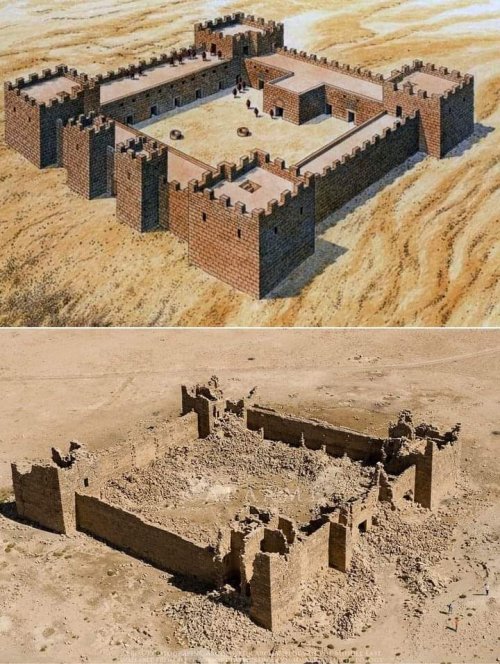
Situated in the Jordanian desert, Qasr Bashir stands out as an impeccably preserved Roman fort. Its condition is remarkable, largely due to it not being overbuilt by subsequent civilizations.
Part of the defensive network known as the Limes Arabicus, Qasr Bashir played a crucial role in safeguarding the Arabian province from the nomadic tribes of the desert. These tribes, while not highly dangerous or overly aggressive, posed a threat due to their fast-moving dromedaries. In response, the Limes Arabicus, with fortifications like Mobene (the ancient name for Qasr Bashir), was established to prevent potential raids on Roman territories.
Constructed in the early 4th century AD, Qasr Bashir's architecture remains largely intact. Its walls, reaching heights of up to 20 feet in some areas, enclose a fortress that still showcases its main entrance and towering corner structures that extend two stories high.
Historically, it is believed that Qasr Bashir was the base for an auxiliary cavalry unit responsible for defending the Roman border and maintaining peace in the vicinity.
The interior courtyard, which houses two cisterns, is encircled by twenty-three rooms, identified as stables. Above these, a second floor likely served as living quarters for the soldiers, with the rooftop offering a substantial platform for defense. One particular room, located directly across from the main gate, is thought to have served as a command center or sanctuary, possibly fulfilling both roles.
The stables, each accommodating three horses, indicate that the cavalry unit stationed here consisted of approximately 120 to 150 soldiers, underscoring the strategic importance of Qasr Bashir in the Roman military network.- Images: @APAAME. Reconstruction from Campbell DB, Roman Auxiliary forts 27 BC - AD 378. Fortress Series 83. Osprey Military Publishing, 2009. P. 58.
Part of the defensive network known as the Limes Arabicus, Qasr Bashir played a crucial role in safeguarding the Arabian province from the nomadic tribes of the desert. These tribes, while not highly dangerous or overly aggressive, posed a threat due to their fast-moving dromedaries. In response, the Limes Arabicus, with fortifications like Mobene (the ancient name for Qasr Bashir), was established to prevent potential raids on Roman territories.
Constructed in the early 4th century AD, Qasr Bashir's architecture remains largely intact. Its walls, reaching heights of up to 20 feet in some areas, enclose a fortress that still showcases its main entrance and towering corner structures that extend two stories high.
Historically, it is believed that Qasr Bashir was the base for an auxiliary cavalry unit responsible for defending the Roman border and maintaining peace in the vicinity.
The interior courtyard, which houses two cisterns, is encircled by twenty-three rooms, identified as stables. Above these, a second floor likely served as living quarters for the soldiers, with the rooftop offering a substantial platform for defense. One particular room, located directly across from the main gate, is thought to have served as a command center or sanctuary, possibly fulfilling both roles.
The stables, each accommodating three horses, indicate that the cavalry unit stationed here consisted of approximately 120 to 150 soldiers, underscoring the strategic importance of Qasr Bashir in the Roman military network.- Images: @APAAME. Reconstruction from Campbell DB, Roman Auxiliary forts 27 BC - AD 378. Fortress Series 83. Osprey Military Publishing, 2009. P. 58.