

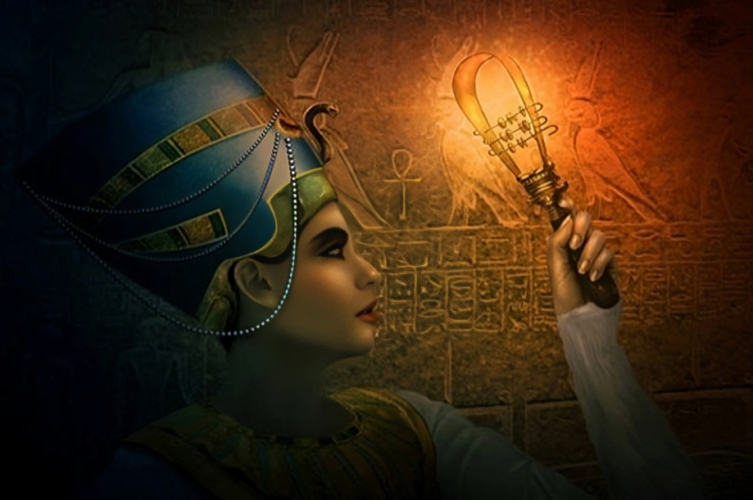
Nefertiti was the wife of the Egyptian pharaoh Akhenaten (formerly Amenhotep IV), who reigned from approximately 1353 to 1336 BC. Known as the Ruler of the Nile and Daughter of the Gods, Nefertiti acquired unprecedented power and was considered to have equal status with the pharaoh himself. However, after the twelfth year of Akhenaten's reign, when her name disappeared from the pages of history, there is much controversy about Nefertiti.
In the new state of Akhenaten, whose religion centered on the sun god, he and Nefertiti were depicted as the primitive first couple. Nefertiti was also known throughout Egypt for her beauty. It was said that she was proud of her long swan-like neck and invented her own cosmetics using the plant galena. Her name is also associated with the oblong gold beads called nefer, which she often wore.
Long forgotten by history, Nefertiti became famous when her bust was discovered in 1912 in the ruins of the artist's studio in Amarna, which is now located in the Altes Museum in Berlin. The bust is one of the most copied works of Ancient Egypt.
Nefertiti is depicted in pictures and statues in a large image denoting her importance. Many of her images show simple family gatherings with her husband and daughters. She is also known as the mother-in-law and stepmother of Pharaoh Tutankhamun.
Nefertiti's kinship is not exactly known, but it is generally accepted that she was the daughter of Aya, who became pharaoh after Tutankhamun. She had a younger sister, Mutnemenjet. Another theory identifies Nefertiti with the Mitannian princess Taduhipa.

Nefertiti was married to Amenhotep IV around 1357 BC. and later became his queen. There are images of Nefertiti and the king riding a chariot together, kissing in public, and Nefertiti sitting on the king's knee, leading scholars to conclude that their relationship was sincere. The legendary love of King Akhenaten can be traced in the hieroglyphs at Amarna, and he even wrote a love poem for Nefertiti:
...And the heiress, great in the palace, beautiful in face, adorned with a double plume, lady of happiness, gifted with favors, hearing whose voice the king rejoices, chief the king’s wife, his beloved, mistress of two lands, Neferneferuaten-Nefertiti, may she live forever and always...”
The couple had six famous daughters, two of whom became queens of Egypt: Meritaten (it is believed that she was her father’s queen) , Meketaten, Ankhesenpaaten/Ankhesenamen (later Queen of Tutankhamun), Neferneferuaten-Tasherit, Neferneferure and Setepenre
New Religion
In the fourth year of the reign of Amenhotep IV, the sun god Aten became the dominant national god.The king carried out a religious revolution, closing the old temples and increasing the central role of Aten. Nefertiti played a prominent role in the old religion, and this continued in the new system.She worshiped alongside her husband and held the unusual royal position of priest of Aten. In the new, almost monotheistic religion, the king and queen were seen as the "primitive first couple" through whom Aten bestowed his blessings. Thus, they formed a royal triad or trinity with Aten, through which the "light" of Aten spread to the entire population.
During Akhenaten's reign (and perhaps afterwards), Nefertiti enjoyed unprecedented power, and by the twelfth year of his reign there is evidence that she may have been elevated to the status of co-ruler, equal in status to the pharaoh himself. She is often depicted on the walls of temples in the same size as him, indicating her importance, and is depicted alone worshiping the god Aten.
Perhaps most impressively, Nefertiti is depicted in a relief from the temple at Amarna slaying a foreign enemy with her mace in front of Aten. Such images were traditionally reserved only for the pharaoh, but Nefertiti was depicted as such.
The figure of Nefertiti was carved into the four corners of Akhenaten's granite sarcophagus, and she is depicted as the protector of his mummy - a role traditionally played by Egypt's traditional female deities: Isis, Nephthys, Selket and Neith.
Disappearance of Nefertiti
In the 12th year of her reign, the name Nefertiti ceases to appear. Some believe that she either died from a plague that swept through the area or fell into disuse, but recent theories refute this claim.
Soon after her disappearance from historical records, Akhenaten acquired a co-ruler with whom he shared the throne of Egypt. This has led to much speculation regarding the man's identity. One theory says that it was Nefertiti herself in a new guise as a female king, following the historical role of other female leaders such as Sobkneferu and Hatshepsut. Another theory puts forward the idea of the existence of two co-rulers - the male son of Smenkhkare and Nefertiti under the name Neferneferuaten (translated as "Aten shines with radiance [because] the beautiful one has come" or "Aten, perfect in perfection").
Some scholars are of the opinion that Nefertiti took on the role of co-regent during or after the death of Akhenaten. Jacobus Van Dijk, responsible for the Amarna section of the Oxford History of Ancient Egypt, believes that Nefertiti actually became co-regent with her husband, and the role of queen consort passed to her eldest daughter Merietaten (Meritaten), with whom Akhenaten had several children. (In addition, Akhenaten's sarcophagus is decorated with four images of Nefertiti, rather than the usual goddesses, indicating her continued importance to the pharaoh until his death and refuting the idea that she fell out of favor. It also shows that she continued to play the role of a deity or demigods next to Achenaten.
On the other hand, Cyril Aldred, author of Akhenaten: King of Egypt, argues that the funerary shawabti found in Akhenaten's tomb indicates that Nefertiti was simply a queen regnant, not a co-regent, and that she died in the 14th year of Akhenaten's reign, and her daughter had died the year before.
According to some theories, Nefertiti was still alive and influenced the younger courtiers, who married in their teens. Nefertiti had to prepare for her death and for the succession of her daughter, Ankhesenpaaten, now called Ankhsenamun, and her stepson and now son-in-law, Tutankhamun. According to this theory, Neferneferuaten died after reigning for two years and was then succeeded by Tutankhamun, who is believed to have been Akhenaten's son. The new royal couple were young and inexperienced by any estimate of their age. According to this theory, Nefertiti's life should have ended by the third year of Tutankhaten's reign. That same year, Tutankhaten changed his name to Tutankhamun and left Amarna to return the capital to Thebes, as evidence of his return to the official worship of Amun.
Since the records are incomplete, it is possible that future discoveries by archaeologists and historians will develop new theories regarding Nefertiti and her rapid departure from the public scene. To date, the mummy of Nefertiti, the famous and iconic Egyptian queen, has never been found.