

View attachment Spinozavr_protiv_karhorodontozavra(360p)-world72.spcs.bio.mp4
Well-preserved fossilized remains allowed paleontologists to understand the anatomy and lifestyle of the spinosaurus (Spinosaurus aegyptiacus) - the largest carnivorous lizard (15 meters in length), larger in size than the tyrannosaurus and gigantosaurus. The new study is presented in the journal Science.
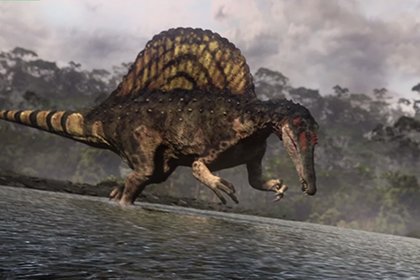
Frame: BBC Earth video on YouTube
Spinosaurs lived in the Cretaceous period in what is now North Africa. The remains of lizards were first found by the German paleontologist Ernst Stromer in 1915, but during the British air raid on Munich in 1944, the local paleontological museum where they were kept was destroyed. Nizar Ibrahim and his colleagues created a three-dimensional digital model of the lizard based on a relatively complete skeleton discovered in the Kem Kem geological formation in Morocco: skull, spine, pelvic girdle, lower limbs.
Scientists say that Spinosaurus aegyptiacus led a semi-aquatic lifestyle, like some crocodiles. For this reason, its anatomy was in many ways unusual for a dinosaur: the nostrils moved to the middle of the skull (so as not to submerge under water), huge conical teeth went into the front of the muzzle (this helped to grab fish), the center of gravity moved forward, which is why Spinosaurs had difficulty walking and swimming easily. Like the first cetaceans, a small pelvis and muscular thighs helped the lizard to swim, and the wide webbed feet were adapted not for walking on land, but for moving through mud (on four legs) and rowing in water.
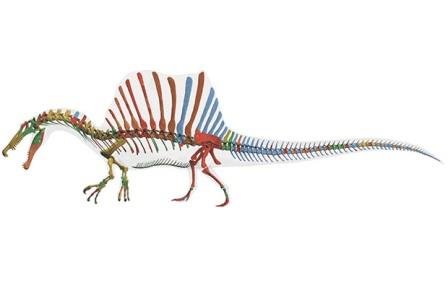
Image: Tyler Keillor, Lauren Conroy, and Erin Fitzgerald
Finally, the distinctive "sail" on the dinosaur's back was covered in skin and was visible to everyone, even when the Spinosaurus dived into the water. Paleontologists suggest that it served a decorative function (attracting individuals of the opposite sex) and did not play any role in thermoregulation.
Although the Spinosaurus defeats the Tyrannosaurus Rex in Jurassic Park III, these dinosaurs lived in different eras on different continents. These dinosaurs ate sharks, saw-nosed rays and lungfish. The transition to such food, and in general to an amphibian image, was something exceptional for dinosaurs - and spinosaurs were a rare evolutionary experiment, scientists emphasize.
Well-preserved fossilized remains allowed paleontologists to understand the anatomy and lifestyle of the spinosaurus (Spinosaurus aegyptiacus) - the largest carnivorous lizard (15 meters in length), larger in size than the tyrannosaurus and gigantosaurus. The new study is presented in the journal Science.
Frame: BBC Earth video on YouTube
Spinosaurs lived in the Cretaceous period in what is now North Africa. The remains of lizards were first found by the German paleontologist Ernst Stromer in 1915, but during the British air raid on Munich in 1944, the local paleontological museum where they were kept was destroyed. Nizar Ibrahim and his colleagues created a three-dimensional digital model of the lizard based on a relatively complete skeleton discovered in the Kem Kem geological formation in Morocco: skull, spine, pelvic girdle, lower limbs.
Scientists say that Spinosaurus aegyptiacus led a semi-aquatic lifestyle, like some crocodiles. For this reason, its anatomy was in many ways unusual for a dinosaur: the nostrils moved to the middle of the skull (so as not to submerge under water), huge conical teeth went into the front of the muzzle (this helped to grab fish), the center of gravity moved forward, which is why Spinosaurs had difficulty walking and swimming easily. Like the first cetaceans, a small pelvis and muscular thighs helped the lizard to swim, and the wide webbed feet were adapted not for walking on land, but for moving through mud (on four legs) and rowing in water.
Image: Tyler Keillor, Lauren Conroy, and Erin Fitzgerald
Finally, the distinctive "sail" on the dinosaur's back was covered in skin and was visible to everyone, even when the Spinosaurus dived into the water. Paleontologists suggest that it served a decorative function (attracting individuals of the opposite sex) and did not play any role in thermoregulation.
Although the Spinosaurus defeats the Tyrannosaurus Rex in Jurassic Park III, these dinosaurs lived in different eras on different continents. These dinosaurs ate sharks, saw-nosed rays and lungfish. The transition to such food, and in general to an amphibian image, was something exceptional for dinosaurs - and spinosaurs were a rare evolutionary experiment, scientists emphasize.