


A new study offers unusual insight into the role of the Milky Way in ancient Egyptian cosmology. Dr Oru Grauru from the University of Portsmouth believes the streak of stars crossing the sky may have served a number of mythological functions. The study was published in Astronomical History and Heritage.
Researchers believe that the Milky Way was represented by the sky goddess Nut, who was depicted as a star-studded woman protecting the Earth from chaotic waters. Dr. Graur discovered that Nut was often depicted with her arms outstretched at a 45-degree angle, allowing her to span different directions of the Milky Way throughout the year.
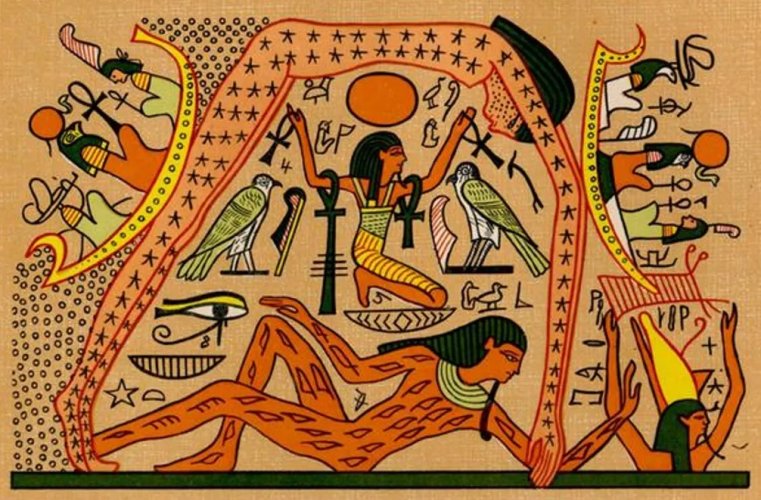
This discovery supports the idea that Nut represented the galaxy. In winter, her arms coincided with the outlines of the Milky Way, and in summer, with her torso (or spine).
Nut - the staircase leading to the afterlife
In an effort to gain further evidence of Nut's connection to the Milky Way, the study's author looked for similarities between her role in ancient Egyptian mythology and other ideas about star gods in cultures around the world. For example, according to one Egyptian text, Nut is described as a "ladder" by which the souls of the dead can ascend to the afterlife.
“Many Native Americans throughout North America view the Milky Way as a road along which the spirits of the dead travel to the afterlife,” Graur writes. “The Milky Way is called by the Lakotas Vanadi Tachanku, the Road of the Spirits, by which the Lakotas go to heaven after death.”
Likewise, the researcher explains that "The dead of the Yucatecan Maya traveled through the Milky Way at night," and the dark rift strip of the Milky Way was imagined as a highway leading directly to the underworld.
The study also found a connection between Chickpeas and bird migration. The Book of Nut states that the birds emerge from the northern tip of the goddess every winter when they migrate south. This connection echoes the idea of the Milky Way as a "Bird's Path" in Finnish, Estonian and Lithuanian cultures.