

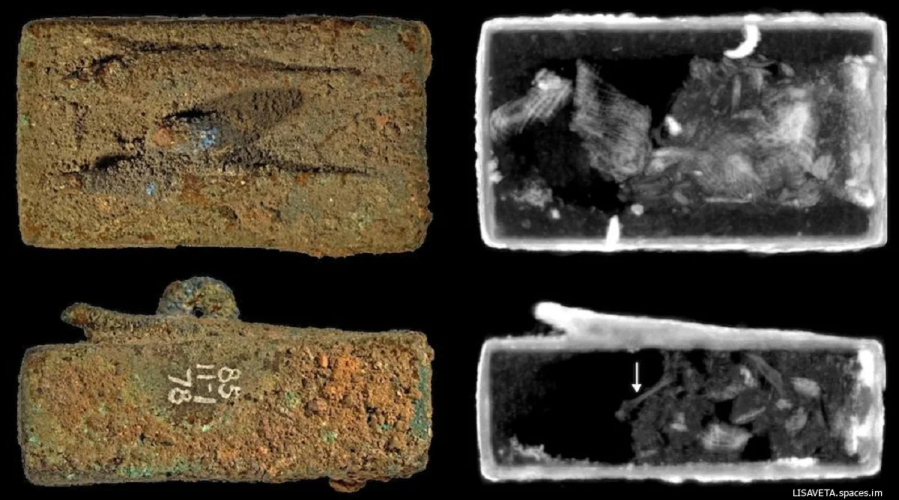
Researchers have begun exploring intriguing ancient Egyptian tombs that turn out to be unusual copper alloy "boxes" that secretly kept their secrets for centuries.
Neutron tomography has shed light on what is really hidden in the depths of these unsolved tombs.
Many small sealed tombs dating from 664 BC. to 300 BC, kept in the British Museum in London. They were discovered in the ancient cities of Naukratis and Tell el-Yehudiah. Modern technologies, including X-ray computed tomography and neutron tomography, were used to uncover the secrets of the contents of these tombs.
What scientists learned
Research published in the journal Nature provided interesting data about their contents. Inside these boxes, ranging in size from 5 to 30 cm, were mummified animal remains. In some of them, mummies of lizards were found, with a particularly well-preserved skull, experts say.
Animal mummification was widespread in ancient Egypt, where some remains were considered physical embodiments of deities, while others were used in ritual performances or offered as offerings to the gods.
In addition to mummies, lead elements and fragments of textiles were found inside the tombs. It is believed that these textile fragments were made from flax, as each animal was wrapped in it before burial.
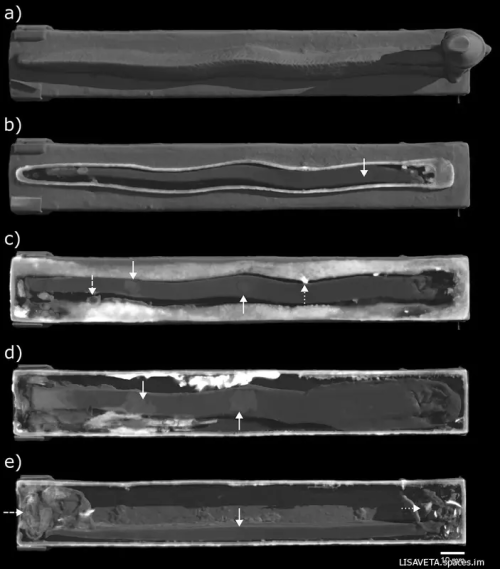
The coffin is decorated with a figurine of an eel. The arrows point to the lead inserts inside. They were used to distribute the weight of a structure or as part of magical rituals. Lead was often used in love spells and curses.
How the Study Was Conducted
Neutron tomography, a technique that creates three-dimensional images of objects by penetrating them with a stream of neutrons, was used to visualize the contents of these six sealed tombs. The choice of this technology was not accidental, since it was the one that was able to easily penetrate the copper alloy that served as the shell for these tombs. Previous attempts to scan the contents using a conventional X-ray procedure had failed.