

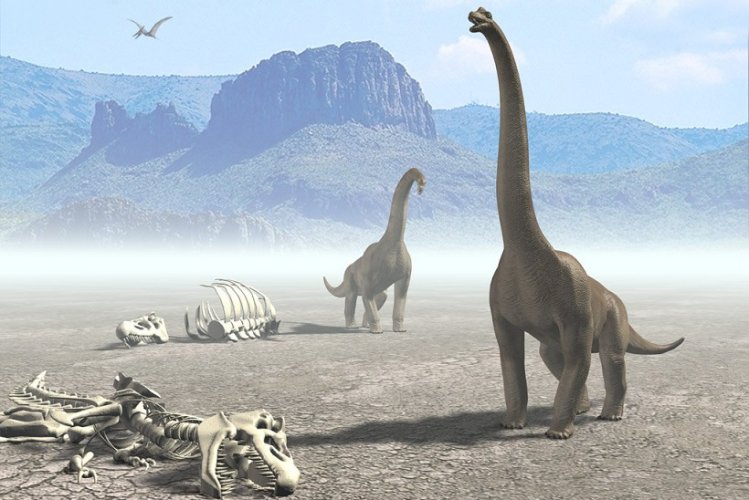
Scientists from McGill University in Montreal found that the cause of the death of dinosaurs was not only a meteorite that fell to Earth, but also massive volcanic eruptions that changed the climate on the planet.
Study author Professor Don Baker presented the results of his paper entitled "Recurring volcanic winters during the last Cretaceous: sulfur and fluorine reserves in Deccan lavas." This work suggests a link between volcanic activity and the extinction of dinosaurs.
The Earth's atmosphere 66 million years ago underwent toxic changes caused not only by an asteroid collision, but also by massive volcanic eruptions. Analysis of sulfur levels showed that before the asteroid impact, volcanic activity and mercury were already significantly influencing the planet's climate.
Research by geologist Sarah Callegaro of the University of Oslo points to the formation of sulfur lava in Western India coinciding with climate change. The new data contradicts previous opinions and confirms that volcanism in the Deccan traps significantly influenced the climate before the disaster.
Although basalt in the region does not typically contain much sulfur, the slow release of the cooling molecule into the atmosphere after an eruption suggests a possible reason for the global drop in temperature. This resulted in periodic drops in temperature of up to 10°C followed by recoveries over the 100,000 years before the asteroid impact.
An international team of scientists studied samples from the West Indian Deccan Traps using cutting-edge techniques at McGill University. Assessing the emissions of sulfur and fluorine in rock samples allows us to take a different look at climatic conditions in ancient times.