

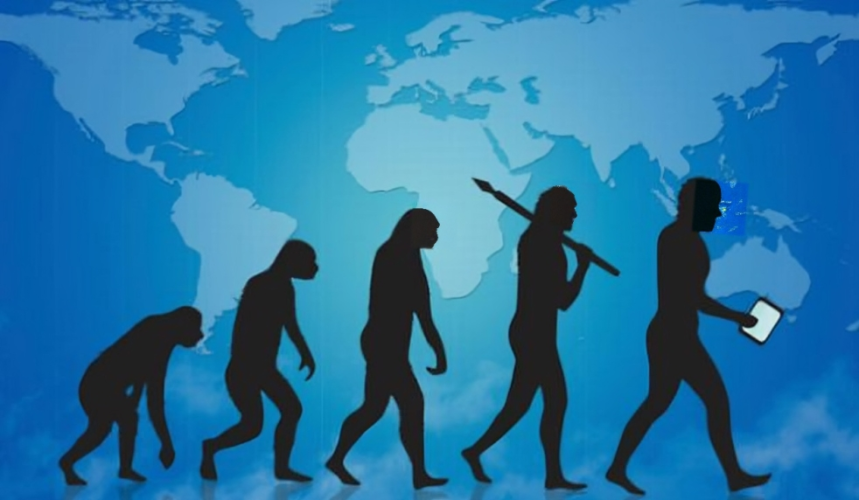
People are still evolving and even faster than before.
The ability of modern medicine to keep people alive on the planet makes one think that evolution has stopped. After all, quality healthcare becomes a hindrance to a key evolutionary force, keeping people alive longer and increasing their chances of passing on their genetic code to future generations.
But if you look at the level of evolution of our DNA, you can see that the development of the human species has not stopped at all, but has even accelerated. Professor of evolutionary genetics Lawrence Hurst writes about this on the pages of Newsweek.
Evolution is a gradual change in the DNA of species over many generations. It can occur through natural selection, where certain traits created by mutations help an organism survive and reproduce. Such mutations are most likely to be passed on to the next generation and subsequently become more common in the population. And so gradually the traits caused by them become an integral part of the entire group. If we look at global DNA research, we see evidence that natural selection has recently made changes and continues to do so. Although modern medicine frees humanity from many causes of death, even in countries with a developed healthcare system, the population continues to evolve.
Those who survive epidemics of infectious diseases drive natural selection by passing on genetic resistance to their offspring. Our DNA proves this as humans have become more resistant to deadly diseases such as Lassa fever and malaria. Natural selection in response to malaria is still ongoing in regions where the disease is still common.
People adapt to their environment. Mutations allowed people to live at higher elevations. They are quite common among the populations of Tibet, Ethiopia and the Andes. The spread of genetic mutations in Tibet was probably the most rapid change in the human body in the last three thousand years. The rapid spread of mutated genes increased the oxygen content in the blood of Tibetans, allowing them to survive in high mountain regions and produce healthy offspring.
Diet is another source of change and adaptation in the human body. Eskimo DNA proves that their people were able to survive in arctic conditions because their bodies adapted to a diet rich in animal fat. Research has also shown that natural selection has caused a mutation that allows adults to produce lactose, an enzyme that breaks down the sugar in milk. And that is why some groups of people today are able to drink it. More than 80% of northwestern Europeans can drink milk. But in East Asia, where it is not widely consumed, lactose intolerance is the norm. The scientist admits that humanity can adapt to consuming products that are considered harmful today. However, despite all these changes, natural selection today affects only 8% of the human genome.