

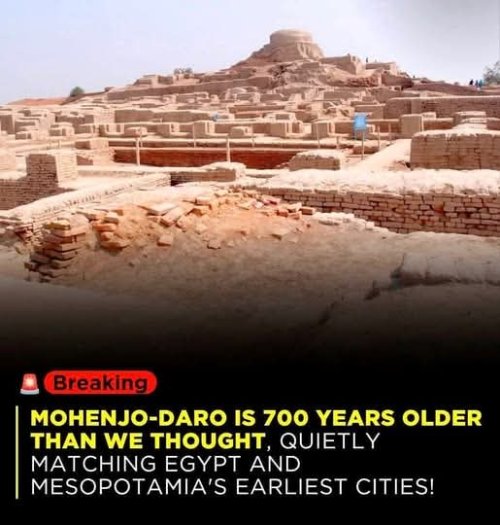
Recent archaeological breakthroughs have rewritten the history of one of the world's most mysterious "lost cities." Excavations at Mohenjo-daro in Sindh, conducted during 2025 and 2026, have revealed that this ancient metropolis is much older than we ever imagined.
Here is a breakdown of these discoveries and why they matter for our understanding of human history.
1. A New Timeline for Civilization.
For decades, historians believed Mohenjo-daro suddenly appeared in its peak form around 2600 BC. However, new radiocarbon dating has pushed its origins back to 3300 BC.
This shift is monumental. It proves that the Indus Valley Civilization wasn't a "late bloomer" compared to Ancient Egypt or Mesopotamia; it was their contemporary, developing alongside them as a founding pillar of human society.
2. The Discovery: More Than Just a Wall.
A team of loca and international experts, including Dr. Asma Ibrahim and Dr. Jonathan Mark Kenoyer, revisited a site originally dismissed in 1950 as a simple flood barrier. Their new analysis reveals a much more complex story:
The City Wall:
The structure is actually a massive city wall that was built and expanded over hundreds of years.
The Hidden Layer:
Beneath the wall, researchers found Kot Diji style pottery. This pottery belongs to an even older settlement, confirming that people were living and building there as early as 3300 BC.
3. Why This Changes Everything.
This evidence replaces the idea of a "sudden" civilization with a story of "gradual evolution".
Instead of appearing out of nowhere, Mohenjo-daro was the result of centuries of experimentation. Over hundreds of years, these early communities slowly perfected the features that eventually made the city famous:
"Grid-based streets" (organized like modern cities).
"Standardized bricks" (proving a unified system of manufacturing).
"Advanced drainage" (some of the world's first indoor plumbing).
"Massive civic structures" like the Great Bath.
4. A Bronze Age Superpower.
At its height, Mohenjo-daro was a massive urban hub, covering over 620 acres and housing roughly 40,000 residents. While much of the world was still learning the basics of farming, the people of the Indus Valley were already master urban planners.
The Bottom Line:
The "cradle of civilization" has effectively shifted further east. These findings prove that the roots of urban life in South Asia are deeper and more sophisticated than we ever dared to believe.