

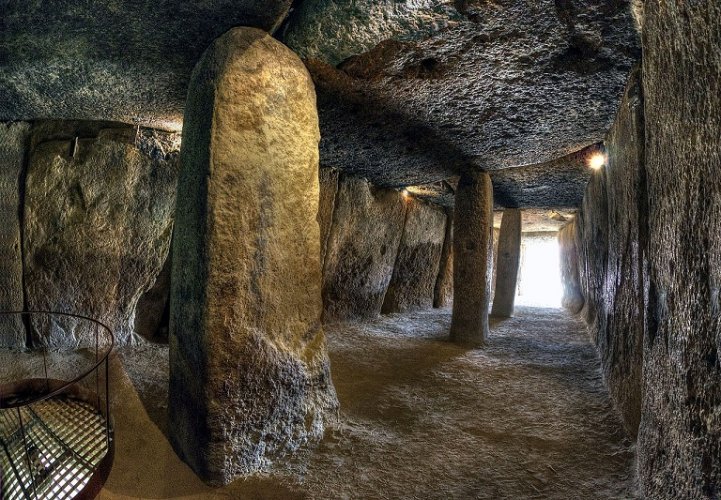
Archaeologists, geologists and historians from several institutions in Spain have discovered that the Menga Dolmen, located near Antequera, represents one of the greatest engineering achievements of the Neolithic. The discovery, published in Scientific Reports, reveals interesting details about the structure and transportation of megalithic stones.
The 5,700-year-old Menga Dolmen has become the focus of an archaeological team that has used new technology to further explore this ancient mound. The structure is impressive in its size. For its construction, stones weighing more than 100 tons were used, which emphasizes the high engineering level of the ancient builders.
The researchers used petrographic and stratigraphic analysis to study the composition of the rocks, revealing that they were calcarenites, a soft and brittle rock. This fact highlights the difficulty of transporting and placing stones of this size without damaging them.
One of the most surprising discoveries is the researchers' assertion that extensive planning and engineering was required to move and place the stones, especially the 150-ton stone that served as the burial ground's roof. They involve the use of scaffolding and ropes, as well as the presence of smooth roads for transportation.
It is interesting to note that the research team suggests that the Meng dolmen was built with a specific direction in mind. Its location creates amazing light patterns inside the chamber, matching the nearby mountains. The placement of stones has also been carefully designed to prevent water seepage and prevent erosion.