

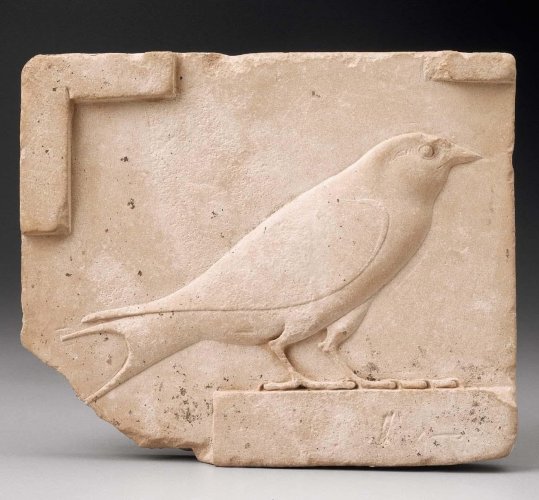
A limestone plaque with a rendering of a swallow in raised relief. It is dated to the Ptolemaic Period (304-30 BCE), and is either a sculptor's model or was used as a votive object.
This is most likely the Egyptian subspecies of the barn swallow. Its binomial nomenclature is Hirundo rustica savignii. A photo of a real one is in the first comment. It was taken near the temple of Khnum in Esna in Upper Egypt.
The heading of chapter 86 of the Book of the Dead states that it is a spell enabling the deceased to appear as a swallow. This transformation is associated with themes of rebirth and resurrection.
Accordingly, the Egyptians hoped and believed that after death they will appear as a living version of their motionless corpses. This version took the form of a swallow (with the head of the deceased) representing the ba, a component of the soul that manifested the desired liberty of movement after death.
This strikingly naturalistic work (07.282), which is 9.9 centimeters in height, is from the collection of the Museum of Fine Arts, Boston, USA.
Photo (edited for size): Museum of Fine Arts