

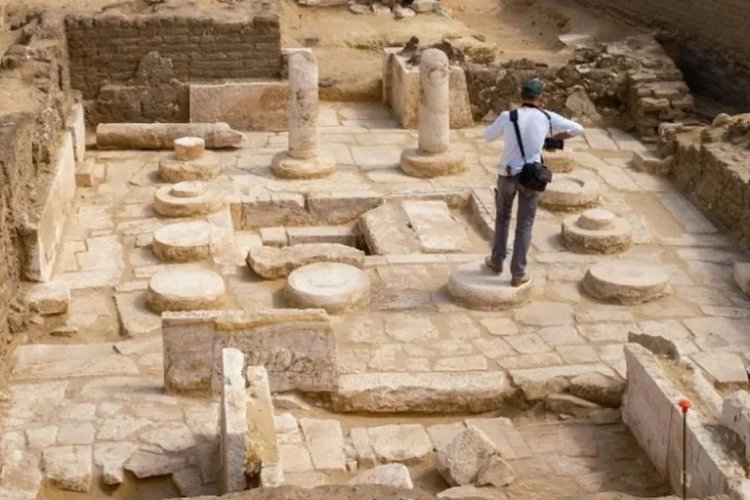
An international archaeological mission, including scientists from the National Museum of Antiquities in Leiden and the Egyptian Museum in Turin, recently carried out excavations at the necropolis of Saqqara. These excavations led to an amazing discovery - the tomb of Panehsi, caretaker of the Temple of Amun.
Panehsi's tomb, which is a free-standing temple with an entrance gate and a pillared courtyard, contains underground burial chambers in which the remains of the tomb owner and his wife Baya, as well as several priests and gift bearers, were found. The walls of the tomb are made of mud brick and decorated with decorative limestone facing slabs, which depict colorful scenes from the life of the owner and his family.
Christian Greco, one of the leaders of the mission, notes that the most beautiful image found in the tomb represents Panehsi himself, worshiping the goddess Hathor. Beneath this image is a scene of Panehsi and his wife sitting together at a donation table. Opposite the couple stands a bald man with a leopard skin on his shoulders, whom researchers believe is the priest responsible for conducting the funeral rites of this married couple.
However, Panehsi's tomb is not the only interesting discovery made by the archaeological mission. During excavations, four more tombs were discovered east of Panehsi's grave. One of them also belonged to the official responsible for making gold foil for the pharaoh's treasury, and the other three tombs probably belonged to other high-ranking officials.

As scientists note, the discovery of tombs indicates that the necropolis of Saqqara was used for a long time, starting from the Old Kingdom and ending with the era of the Late Period. Researchers also note the high degree of preservation of the tombs, which makes it possible to study in more detail the life and customs of that time.
The archaeological mission also discovered numerous artifacts, including ceramics, glass beads, makeup brushes and many other items that complement our picture of the life and culture of Ancient Egypt.
Christian Greco, the head of the mission, emphasized that these finds are a valuable source of information for the study of not only Ancient Egypt, but also for comparison with other cultures of the time. The research will use the most modern technologies, such as laser scanning, X-ray tomography and others, to obtain the most complete information about the artifacts and tombs found.
Overall, this find is an important step in the study of Ancient Egypt and its culture, and its significance cannot be overestimated. The results of the study promise to be fascinating and bring new knowledge about how people lived and thought in those distant times.