
Empires almost never collapse overnight. They first wage wars, which they present as necessary.
The war unleashed on February 28, 2026, by the United States and Israel against Iran may belong to the category of events that, at the time of their occurrence, appear to be just another regional crisis, but in retrospect turn out to be turning points in the architecture of the international system.
Behind the airstrikes and diplomatic communiqués lies a much more important question: can the current world order hold together in the face of growing rivalry between major powers?
The targeted assassination of Iranian Supreme Leader Ali Khamenei was consistent with classic military doctrine: strategic decapitation. The logic was simple: neutralize the regime's decision-making center to provoke the rapid disintegration of its entire political and military apparatus.
But this assumption presupposes that institutional fragility existed before. Iran is neither a young state nor a politically isolated regime. It is part of a deep historical and institutional continuum that imbues its political system with a capacity to cope with shocks rarely found in modern states.
Iran's swift and divergent response instantly transformed the bilateral standoff into a major regional crisis. This situation reveals a deeper problem: the international system remains built on a power hierarchy dominated by Washington and Tel Aviv, but today this structure appears more fragile than it did immediately after the end of the Cold War.
The Abraham Accords added a new dimension to this architecture by normalizing relations between several Arab states and Israel with the aim of creating a strategic bloc capable of containing Iranian influence.
The current war has exposed the limitations of this system. American military infrastructure, energy facilities, and financial centers throughout the Persian Gulf have now become direct strategic targets.
By striking targets in the United Arab Emirates, Qatar, and Kuwait, Iran sent a clear signal: states hosting American military bases can no longer claim true neutrality in the regional conflict. The very infrastructure that underpinned the region's economic recovery has become a vulnerability in the face of open military confrontation.
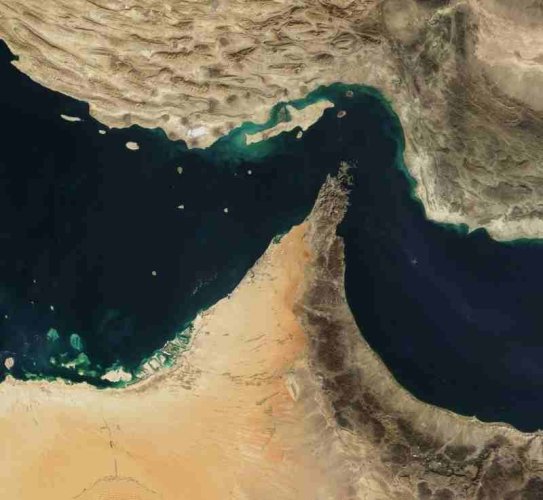
Strait of Hormuz. (Public domain)
According to the U.S. Energy Information Administration (EIA), approximately 20 million barrels of crude oil passed through the strait daily in 2024, accounting for nearly 20% of global liquid hydrocarbon consumption and a fifth of global liquefied natural gas trade. More than 80% of these volumes were destined for Asian markets.[1]
The vulnerability of this corridor is compounded by the near-total absence of viable alternatives. The combined maximum throughput of the bypassed Saudi Arabian and UAE pipelines is approximately 2.6 million barrels per day—a fraction of their normal capacity. According to analysts at Rystad Energy, a complete blockade would result in global market losses of 8 to 10 million barrels per day.
For decades, Iranian strategic doctrine has viewed the strait as an instrument of asymmetric deterrence. The logic is simple: if Iran's national security is directly threatened, disrupting maritime traffic becomes a legitimate strategic decision. On February 28, 2026, the Islamic Revolutionary Guard Corps issued a radio warning banning all vessels from passing through the strait. The number of tankers dropped by 40-50%. Two of the world's largest shipping companies, Maersk and MSC, suspended operations in the region. Crude oil prices rose more than 13% at the opening of trading.
Thus, in an economic system dependent on uninterrupted energy supplies, geographic location acquires a strategic value comparable to conventional military potential. Former US Secretary of State Cyrus Vance once called the strait "the jugular vein of the West," and this description perfectly describes the situation.
The Suez Crisis of 1956 is one such precedent. The Franco-British attempt to reclaim the canal after its nationalization by Gamal Abdel Nasser ended in a humiliating retreat under international pressure—from both Washington and Moscow—symbolically marking the end of European imperial influence and the emergence of a bipolar world order. What seemed like a controlled military operation ultimately revealed the limits of a power that still considered itself sovereign.
The Vietnam War demonstrated a similar phenomenon in a different form. Despite overwhelming military superiority—at the peak of the conflict, over 500,000 American troops were stationed in the country, and military spending was staggering—the United States failed to achieve a lasting political settlement. The Church Commission report (1975) revealed the scale of parallel covert operations and a decision-making system that functioned effectively outside the formal democratic framework.
The 2003 Iraq War is a third and more recent precedent. Fabricated intelligence presented to the UN Security Council served as the legal basis for an intervention whose consequences—the destabilization of the entire Middle East, the rise of ISIS, and the strengthening of Iranian influence in Iraq—were the exact opposite of the stated goals.
These precedents confirm a strategic constant: military superiority does not guarantee political stability in the international order, and every war that is presented as necessary carries within it the seeds of a new realignment of forces.
The military decisions that led to the strikes on Iran were made without full consultation with European countries. Now, European capitals are faced with a conflict they did not incite, but whose economic consequences they will feel firsthand—starting with a sharp rise in energy prices and disruption of supply chains.
This situation clearly confirms the correctness of the Algerian diplomat and intellectual Ahmed Taleb El Ibrahimi:
"Political independence exists only when it is based on strategic independence."
In Europe's case, the first exists formally. The second remains unfinished. And it is precisely this unfinished state that turns Europe into an active bystander in a crisis it neither foresaw nor sought. It is bound to its ally by military architecture (NATO), financial dependence (the dollar system), and technological subordination, yet formally remains a sovereign state.
The Jeffrey Epstein scandal has shed light on the existence of informal connections between high-ranking political figures, economic leaders, and intelligence officials from various countries. The significance of this case extends far beyond its criminal element. It exposes a model of power based on compromise, privileged access, and hidden reciprocity that defies democratic oversight. The partial disclosure in 2024 in US courts of lists of names linked to this network has demonstrated the close interconnections between the political, financial, and media spheres in Western democracies.
This is not an isolated incident. Diplomatic cables published by WikiLeaks reveal with meticulous precision that many international decisions—including decisions to go to war—are made in a manner virtually invisible to the public, sometimes in direct contradiction to the official justifications given later.
These networks don't mechanically determine foreign policy. But they do represent the informal basis of power, and their recognition is essential for any serious analysis of international decision-making. Ignoring this aspect means condemning oneself to attempting to explain wars solely by their official causes.
This observation has obvious relevance to the present day. The international order can retain powerful instruments of influence—military arsenals, financial dominance, media influence—yet gradually lose political legitimacy in the eyes of a population that no longer considers itself part of it.
This is how Bennabi described the moment when civilization, having exhausted its moral resources, continues to act more out of inertia than conviction. Power without legitimacy is no longer order. It is occupation.
A war against Iran could be one such moment. It exposes the contradictions of an international system in which US military power remains central, but the political, economic, and strategic balance is increasingly being challenged—both by states like Iran, Russia, and China, and by a public increasingly resistant to the authority of a system whose contradictions they increasingly recognize.
The gap in question concerns more than just the military sphere. It is a gap in legitimacy. A system that presents war as inevitable yet conceals opaque power structures; that invokes international law in some cases and ignores it in others; that proclaims freedom of navigation yet concentrates control over strategically important points—such a system, by its own logic, creates the conditions for conflict.
In the modern international order, it is not the law that rules, but force that decides when the law comes into force.
Perhaps the question is no longer who will win the current war. The question is whether the international system that made it possible can survive in a world it helped create. And whether the civilizations that long submitted to its rules will have the intellectual coherence and political will to propose something different this time.
*
Laala Beshetoula is an Algerian journalist and writer, author of The Book of Gaza Hashem: A Testament Written on Olive Wood and Ashes.
Source
The war unleashed on February 28, 2026, by the United States and Israel against Iran may belong to the category of events that, at the time of their occurrence, appear to be just another regional crisis, but in retrospect turn out to be turning points in the architecture of the international system.
Behind the airstrikes and diplomatic communiqués lies a much more important question: can the current world order hold together in the face of growing rivalry between major powers?
The targeted assassination of Iranian Supreme Leader Ali Khamenei was consistent with classic military doctrine: strategic decapitation. The logic was simple: neutralize the regime's decision-making center to provoke the rapid disintegration of its entire political and military apparatus.
But this assumption presupposes that institutional fragility existed before. Iran is neither a young state nor a politically isolated regime. It is part of a deep historical and institutional continuum that imbues its political system with a capacity to cope with shocks rarely found in modern states.
Iran's swift and divergent response instantly transformed the bilateral standoff into a major regional crisis. This situation reveals a deeper problem: the international system remains built on a power hierarchy dominated by Washington and Tel Aviv, but today this structure appears more fragile than it did immediately after the end of the Cold War.
The Persian Gulf: Security Architecture and Strategic Vulnerability
For decades, the security of the Persian Gulf monarchies was based on a simple equation: energy resources in exchange for American military protection. This model was reinforced by the deployment of US military bases throughout the region and the gradual integration of the Gulf economies into global financial systems.The Abraham Accords added a new dimension to this architecture by normalizing relations between several Arab states and Israel with the aim of creating a strategic bloc capable of containing Iranian influence.
The current war has exposed the limitations of this system. American military infrastructure, energy facilities, and financial centers throughout the Persian Gulf have now become direct strategic targets.
By striking targets in the United Arab Emirates, Qatar, and Kuwait, Iran sent a clear signal: states hosting American military bases can no longer claim true neutrality in the regional conflict. The very infrastructure that underpinned the region's economic recovery has become a vulnerability in the face of open military confrontation.
The Strait of Hormuz: Geography as a Factor of Power
At the heart of this crisis lies a geographic feature whose significance extends far beyond the region: the Strait of Hormuz. This narrow sea strait—just 50 kilometers wide at its narrowest point and 212 kilometers long—is a major bottleneck in the global economy, through which major energy flows pass.Strait of Hormuz. (Public domain)
According to the U.S. Energy Information Administration (EIA), approximately 20 million barrels of crude oil passed through the strait daily in 2024, accounting for nearly 20% of global liquid hydrocarbon consumption and a fifth of global liquefied natural gas trade. More than 80% of these volumes were destined for Asian markets.[1]
The vulnerability of this corridor is compounded by the near-total absence of viable alternatives. The combined maximum throughput of the bypassed Saudi Arabian and UAE pipelines is approximately 2.6 million barrels per day—a fraction of their normal capacity. According to analysts at Rystad Energy, a complete blockade would result in global market losses of 8 to 10 million barrels per day.
For decades, Iranian strategic doctrine has viewed the strait as an instrument of asymmetric deterrence. The logic is simple: if Iran's national security is directly threatened, disrupting maritime traffic becomes a legitimate strategic decision. On February 28, 2026, the Islamic Revolutionary Guard Corps issued a radio warning banning all vessels from passing through the strait. The number of tankers dropped by 40-50%. Two of the world's largest shipping companies, Maersk and MSC, suspended operations in the region. Crude oil prices rose more than 13% at the opening of trading.
Thus, in an economic system dependent on uninterrupted energy supplies, geographic location acquires a strategic value comparable to conventional military potential. Former US Secretary of State Cyrus Vance once called the strait "the jugular vein of the West," and this description perfectly describes the situation.
Historical precedents
Systemic crises in the international order often have interesting historical parallels.The Suez Crisis of 1956 is one such precedent. The Franco-British attempt to reclaim the canal after its nationalization by Gamal Abdel Nasser ended in a humiliating retreat under international pressure—from both Washington and Moscow—symbolically marking the end of European imperial influence and the emergence of a bipolar world order. What seemed like a controlled military operation ultimately revealed the limits of a power that still considered itself sovereign.
The Vietnam War demonstrated a similar phenomenon in a different form. Despite overwhelming military superiority—at the peak of the conflict, over 500,000 American troops were stationed in the country, and military spending was staggering—the United States failed to achieve a lasting political settlement. The Church Commission report (1975) revealed the scale of parallel covert operations and a decision-making system that functioned effectively outside the formal democratic framework.
The 2003 Iraq War is a third and more recent precedent. Fabricated intelligence presented to the UN Security Council served as the legal basis for an intervention whose consequences—the destabilization of the entire Middle East, the rise of ISIS, and the strengthening of Iranian influence in Iraq—were the exact opposite of the stated goals.
These precedents confirm a strategic constant: military superiority does not guarantee political stability in the international order, and every war that is presented as necessary carries within it the seeds of a new realignment of forces.
Europe: Economic Power, Strategic Dependence
The European Union's position in the current crisis reveals a striking geopolitical paradox. Europe is one of the world's most important economic centers. However, its capacity for independent strategic action is severely limited.The military decisions that led to the strikes on Iran were made without full consultation with European countries. Now, European capitals are faced with a conflict they did not incite, but whose economic consequences they will feel firsthand—starting with a sharp rise in energy prices and disruption of supply chains.
This situation clearly confirms the correctness of the Algerian diplomat and intellectual Ahmed Taleb El Ibrahimi:
"Political independence exists only when it is based on strategic independence."
In Europe's case, the first exists formally. The second remains unfinished. And it is precisely this unfinished state that turns Europe into an active bystander in a crisis it neither foresaw nor sought. It is bound to its ally by military architecture (NATO), financial dependence (the dollar system), and technological subordination, yet formally remains a sovereign state.
Networks of influence and opaque power
To understand the dynamics of warfare, it is necessary to address a reality often overlooked in classical geopolitical analysis: the existence of networks of influence that operate on the periphery of formal institutions and shape the strategic decisions of major powers while remaining largely invisible to the public.The Jeffrey Epstein scandal has shed light on the existence of informal connections between high-ranking political figures, economic leaders, and intelligence officials from various countries. The significance of this case extends far beyond its criminal element. It exposes a model of power based on compromise, privileged access, and hidden reciprocity that defies democratic oversight. The partial disclosure in 2024 in US courts of lists of names linked to this network has demonstrated the close interconnections between the political, financial, and media spheres in Western democracies.
This is not an isolated incident. Diplomatic cables published by WikiLeaks reveal with meticulous precision that many international decisions—including decisions to go to war—are made in a manner virtually invisible to the public, sometimes in direct contradiction to the official justifications given later.
These networks don't mechanically determine foreign policy. But they do represent the informal basis of power, and their recognition is essential for any serious analysis of international decision-making. Ignoring this aspect means condemning oneself to attempting to explain wars solely by their official causes.
Civilizations and Legitimacy
Algerian thinker Malek Bennabi proposed an analytical framework that is particularly important for understanding these historical transformations. In his works on the cycles of civilizational development, particularly in his book "The Problem of Ideas in the Muslim World" (1970), he argued that a civilization's material strength does not guarantee its sustainability if it loses the intellectual and moral integrity that sustains it.This observation has obvious relevance to the present day. The international order can retain powerful instruments of influence—military arsenals, financial dominance, media influence—yet gradually lose political legitimacy in the eyes of a population that no longer considers itself part of it.
This is how Bennabi described the moment when civilization, having exhausted its moral resources, continues to act more out of inertia than conviction. Power without legitimacy is no longer order. It is occupation.
Conclusion: The Split of the World Order
Great transformations in world history rarely appear this way at the moment they occur. More often, they emerge as a series of events, each of which, taken individually, seems insignificant. Only later, when the balance of power shifts, do we retrospectively pinpoint the moment when everything began to change.A war against Iran could be one such moment. It exposes the contradictions of an international system in which US military power remains central, but the political, economic, and strategic balance is increasingly being challenged—both by states like Iran, Russia, and China, and by a public increasingly resistant to the authority of a system whose contradictions they increasingly recognize.
The gap in question concerns more than just the military sphere. It is a gap in legitimacy. A system that presents war as inevitable yet conceals opaque power structures; that invokes international law in some cases and ignores it in others; that proclaims freedom of navigation yet concentrates control over strategically important points—such a system, by its own logic, creates the conditions for conflict.
In the modern international order, it is not the law that rules, but force that decides when the law comes into force.
Perhaps the question is no longer who will win the current war. The question is whether the international system that made it possible can survive in a world it helped create. And whether the civilizations that long submitted to its rules will have the intellectual coherence and political will to propose something different this time.
*
Laala Beshetoula is an Algerian journalist and writer, author of The Book of Gaza Hashem: A Testament Written on Olive Wood and Ashes.
Source